
Tree Removal Cost in Lilburn, Explained Without the Runaround
Nobody enjoys spending money on a tree. What you’re actually buying is the end of checking on it every time the wind gets up. If you are weighing up tree removal cost Lilburn right now, this walks through what we look at, what moves the price, and what actually happens on the day.
The straight answer: tree removal cost Lilburn is priced off size, lean, access, what sits underneath and cleanup. We come look first, then put a number in writing.
What we run into around Lilburn specifically
The oldest suburban canopy in Gwinnett – 1960s-70s lots with trees now fifty to seventy years old and genuinely at end of life That shapes almost everything about how a job gets planned here.
- This is the oldest suburban canopy in Gwinnett, and it shows. Water oaks planted or retained in the 1960s and 70s are now well past the hollowing threshold. Willow oaks are enormous. Loblolly pines are far past safe height. If there is one city in the footprint where trees are actively at end-of-life, it’s Lilburn
- Utility line conflicts are severe: old neighborhoods with overhead lines and fifty years of unmanaged growth into them
- Trees directly over 1960s–70s ranch houses with low roof lines and no room to maneuver. Near-structure removal is the dominant job
- Older, narrower lots mean tight access, close neighbors, and rigging rather than felling
So when we are out around the Rockbridge corridor, the Indian Trail corridor and the Parkview area, those are the first things we check. If you are anywhere near the Camp Creek Greenway and the Yellow River, or off Rockbridge Road, you are well inside our normal run.
Lilburn is one of the oldest suburban parts of Gwinnett. Old Town Lilburn has genuinely historic homes. The surrounding neighborhoods were built through the 1960s, 70s and 80s on wooded lots — which means the trees on them are now fifty to seventy years old, the oldest suburban canopy in the county
Very diverse and price-conscious — plain simple English and a direct answer on cost are essential BAPS Shri Swaminarayan Mandir is the landmark everyone in south Gwinnett knows Root heave on old sidewalks and driveways — a visible, teachable warning sign
“Old Town” means the historic center of Lilburn. “The Mandir” or “the temple” means BAPS Shri Swaminarayan Mandir and everyone in south Gwinnett knows it. “Twenty-nine” for US-29 / Lawrenceville Highway. “Killian Hill” is an area, not just a road. “Five Forks” spans into Lawrenceville and Snellville. “Parkview” means the high school and its district identity That matters more than it sounds, because when somebody calls and says which side of town they are on, we already know the access and the tree cover before we get there.
Summer storms drop the big willow oak limbs. Fall dead-tree calls. Winter leaf-off inspections reveal what’s actually dead in these old crowns Because of that, the same tree can be a straightforward morning in one month and a genuinely awkward job in another, and we would rather tell you that up front than discover it with a machine already on your lawn. For the wider picture on tree condition and care in this region, USDA Forest Service publishes solid homeowner guidance.
Why we’ll sometimes talk you out of it
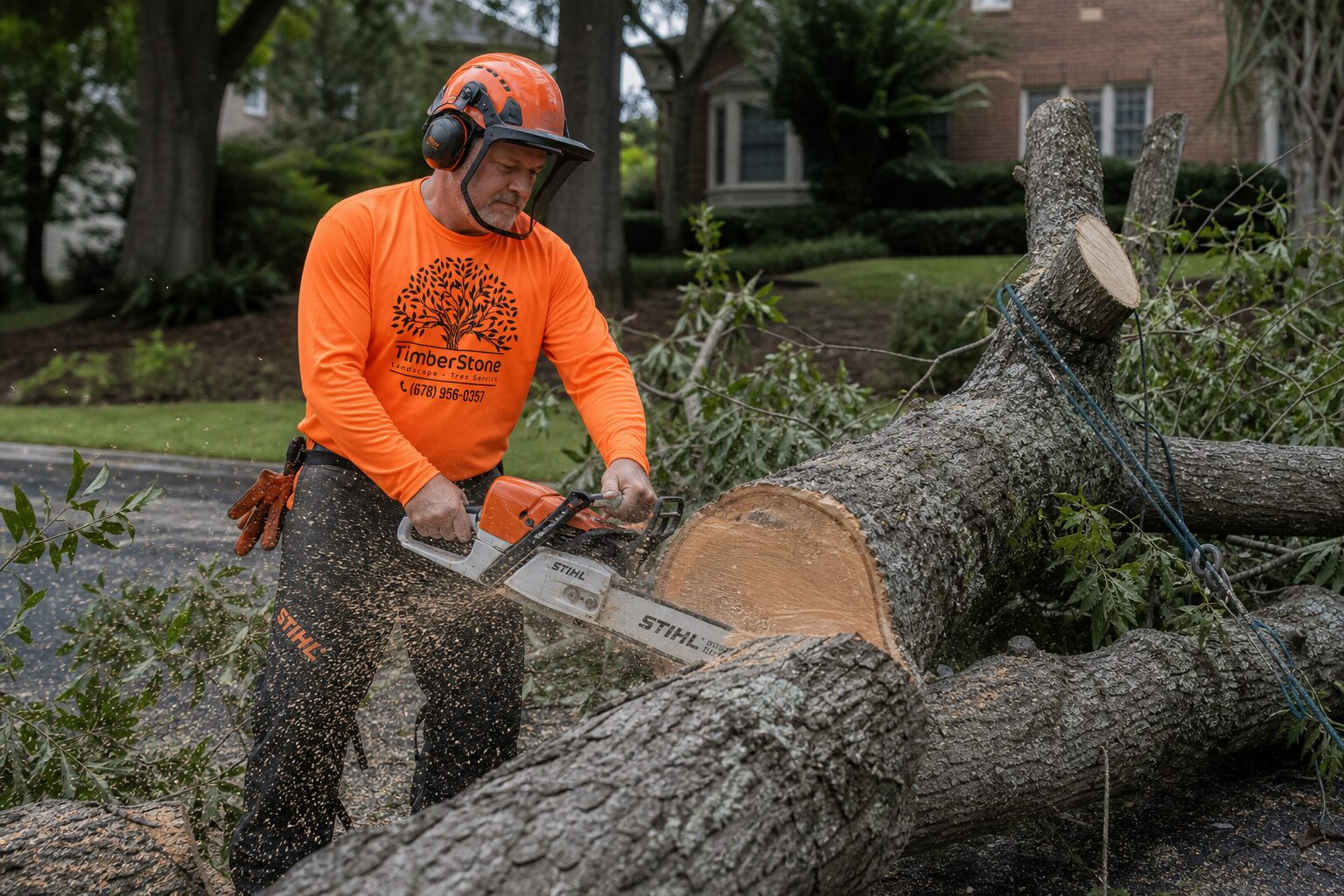
We lose jobs over this. Somebody gets three quotes, two say remove, we say prune and monitor, and they go with the majority. That’s fair enough, and we’d still rather be the odd one out than tell you something we don’t believe.
Most tree companies quote removal on everything, because removal pays more than pruning. We’d rather tell you when a tree can be saved, even though it makes us less money that day. We’d rather be the company you call for the next fifteen years. That is also why we put the reasoning in writing. You can read what we are seeing and decide for yourself, instead of taking our word for it. If you want the longer breakdown, we walk through it on our best tree removal Lilburn page.
The job isn’t finished when the tree is down. It’s finished when your yard is clean.
Where the hours go on a tree job
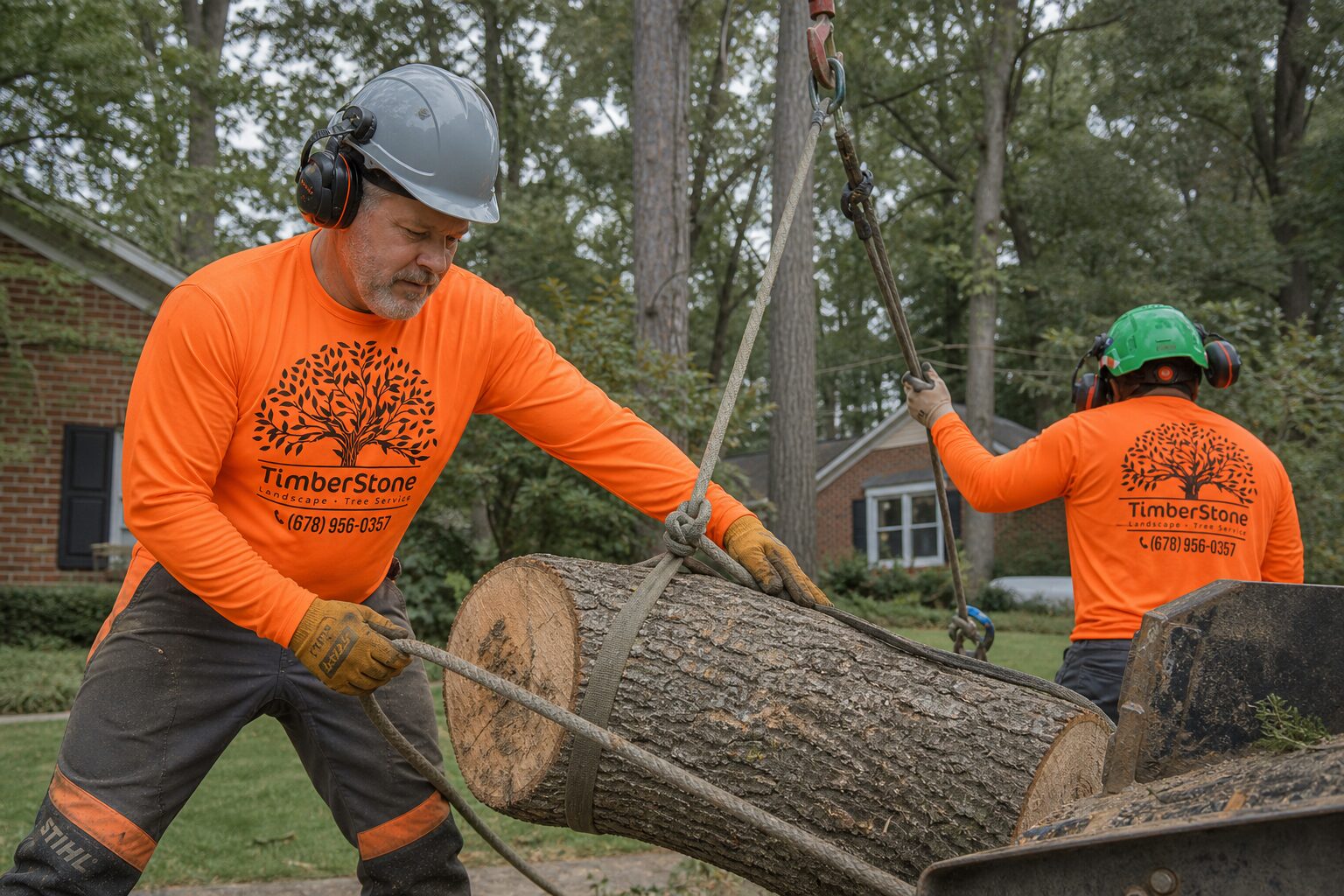
Rigging is the part that takes the time. Every piece gets tied, cut, lowered and untied. On a tree over a roof that’s a few minutes per piece and there may be forty pieces, which is why a tight removal is a day and an open one is an hour.
Setup is the invisible cost. Mats over soft ground, plywood on the drive, protection over a pool coping, cones and a spotter if the work touches the street. It buys nothing visible and prevents everything expensive.
The assessment is where the price is really decided. We’re working out whether this tree can be felled whole, whether it has to come apart in pieces, and whether a machine can reach it. Those three answers can triple a number or halve it.
Every removal runs the same sequence: assess, plan the drop zone, set up protection, rig, section, chip, clean. Skip a step and you get either damage or a much bigger bill, which is why the order matters more than the speed.
Cleanup closes it out. Rake, blow, walk the yard, load the last of it. The number on your quote should already include this. If it doesn’t, you haven’t been quoted the whole job.
Either way, you will know exactly what you are dealing with and what it costs before anything happens.
Now, here’s the part almost nobody mentions on the phone
Here is what most homeowners never get told: the number on a quote is mostly a story about access, not about the tree. Two identical oaks, one by the driveway and one behind a fence in the back corner, are genuinely different jobs.
Why the quote is what it is
Season and ground condition shift the number too. The same job after two dry weeks and after two wet ones are not the same job, because one of them needs matting and the other doesn’t.
Species plays a part. A water oak full of decay comes apart unpredictably and has to be treated with more caution than a sound pine of the same size, and caution is measured in hours.
Proximity to power changes everything. Anything near a service drop needs extra care, sometimes a utility drop, and always more time. It’s not padding, it’s the difference between a safe job and a bad day.
Distance to the truck matters more than people expect. Every piece has to get from where it lands to where it’s loaded, and a hundred feet of carrying through a back gate adds up over a full day.
How the work actually goes
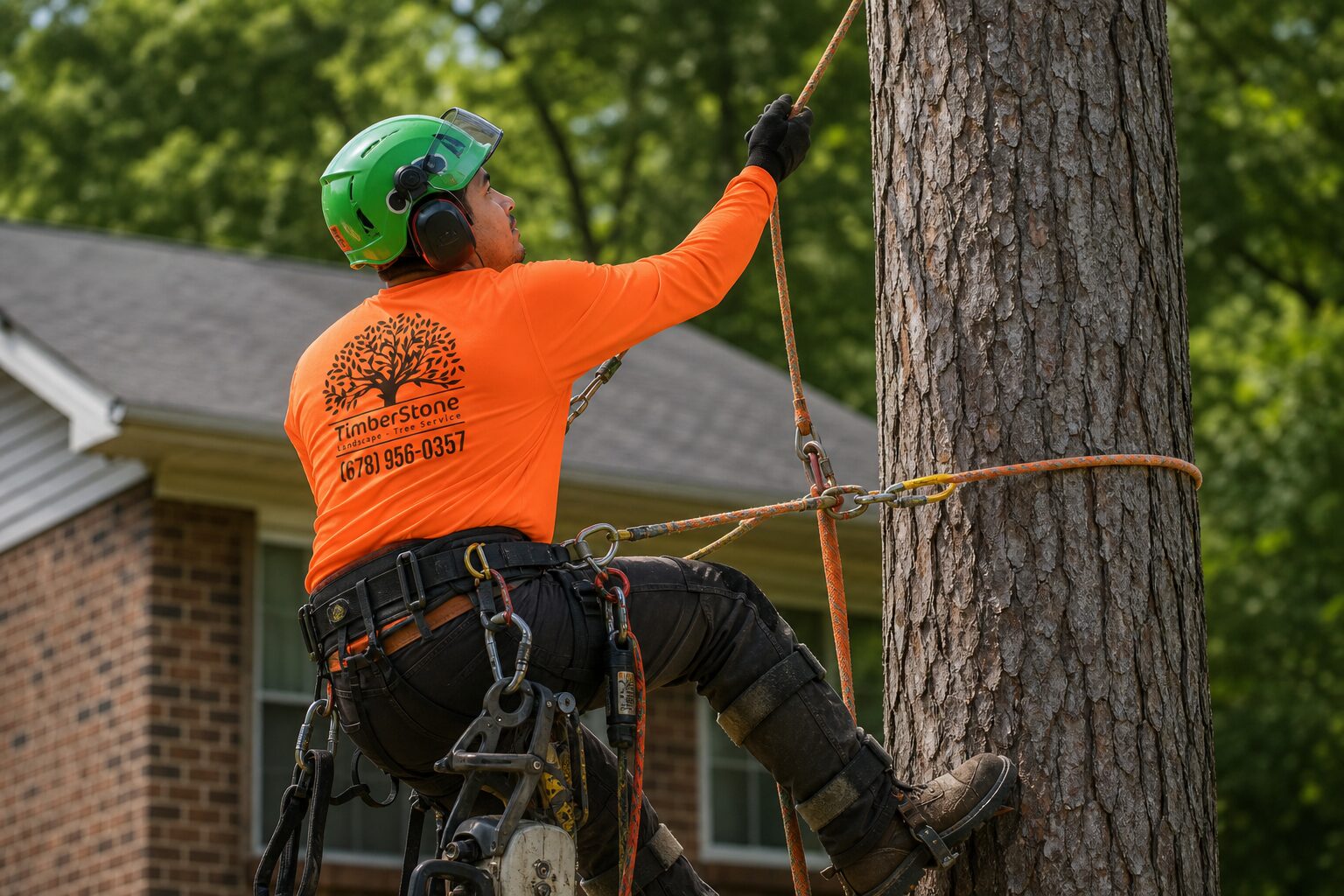
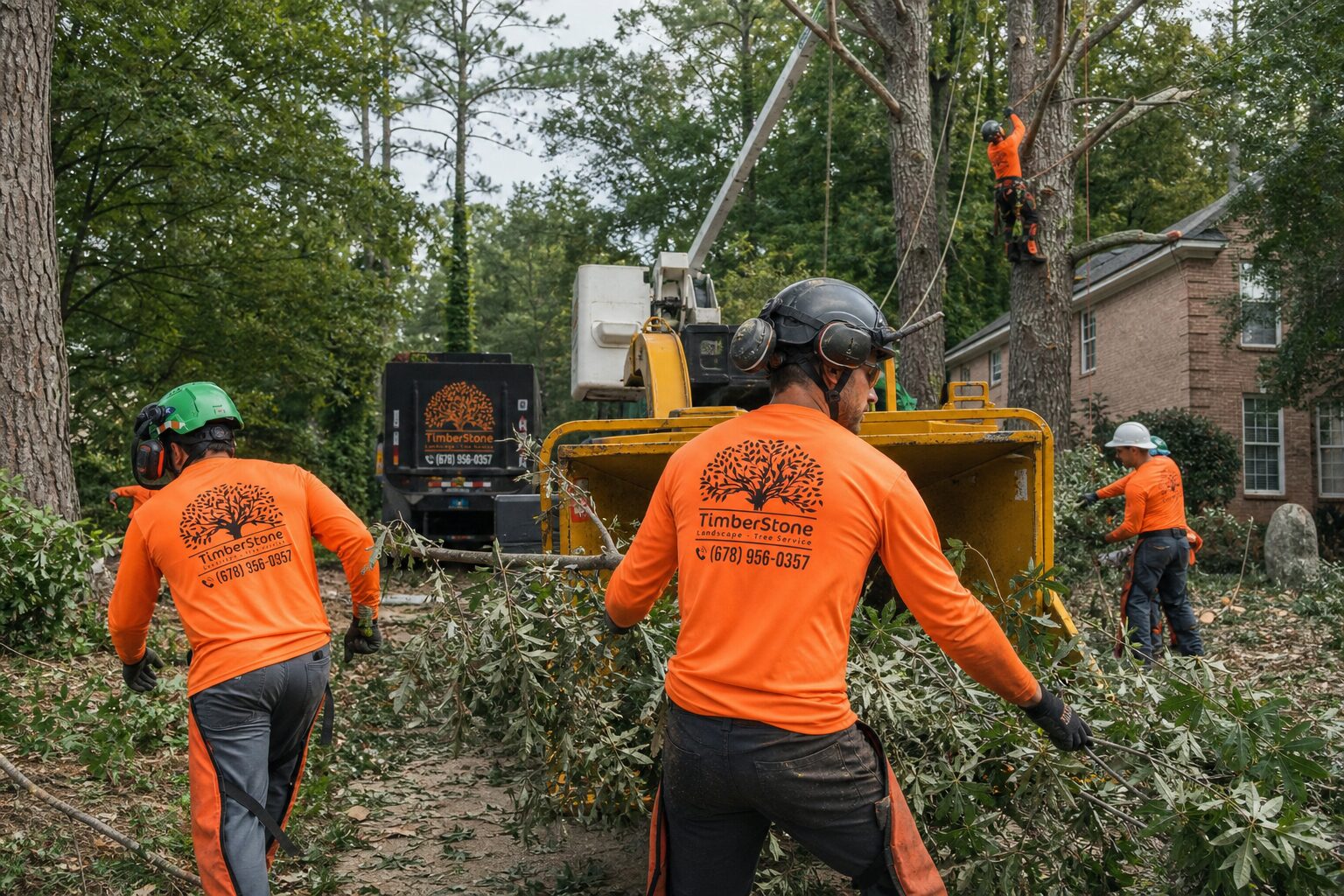
If there’s room to fell it whole, we fell it whole. Most yards don’t have room. So the tree comes apart in pieces, rigged and lowered on ropes, or picked off by crane and set down where we want it.
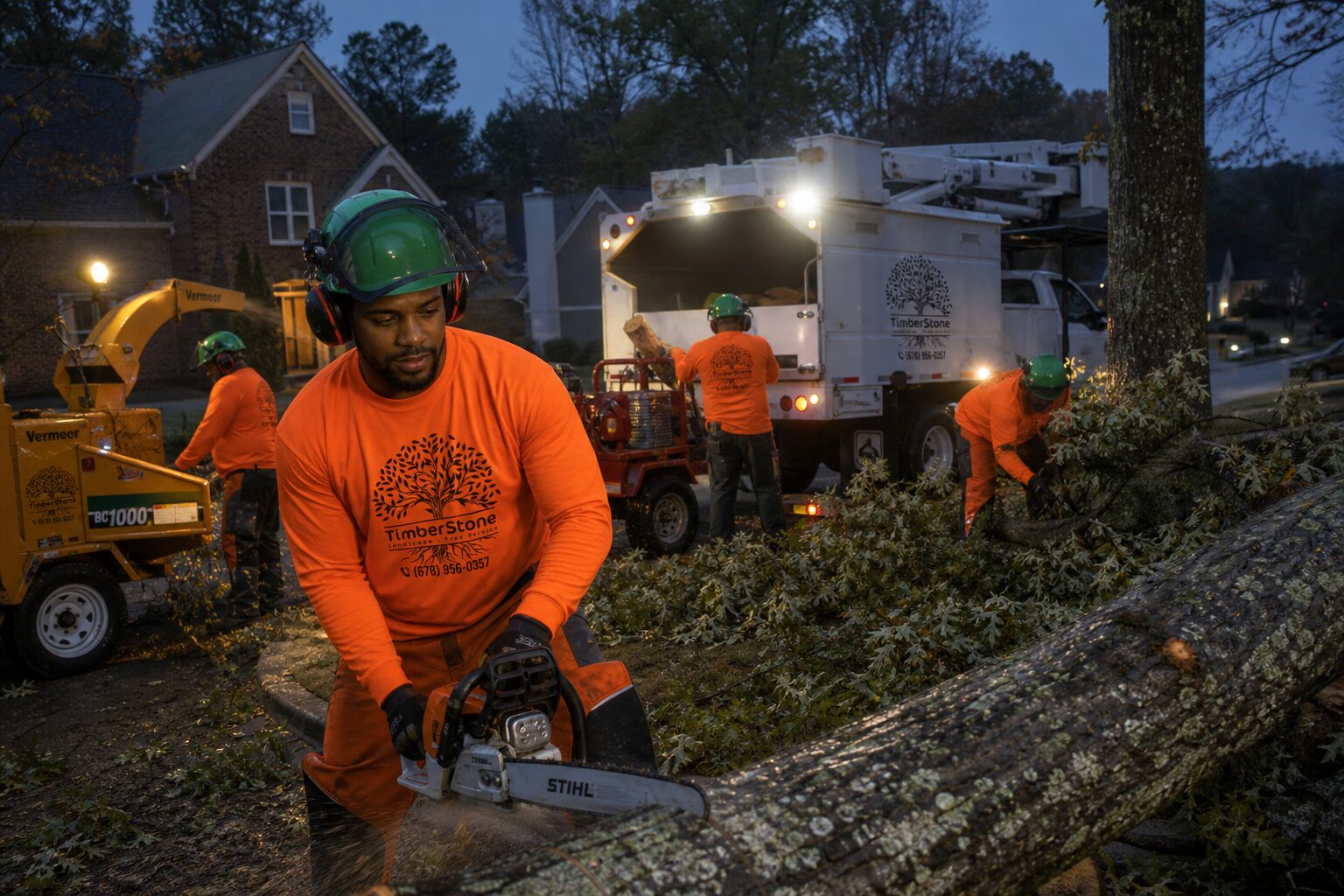
While the climber works, the ground crew keeps the drop zone clear and feeds the chipper. A tidy ground operation is genuinely a safety feature, not just housekeeping.
We walk the route the equipment will take before anything drives on it. Where the ground is soft, mats go down. Where there’s irrigation or a septic field, we go around it, even when that costs us an hour.
Then comes the setup. Mats or plywood over soft ground, protection on anything that can be scratched, and the drop zone cleared and roped off. Setup takes longer than people expect, and it’s where damage gets prevented.
The single most common mistake we see, and the easy way around it
Ask any company this one question before they set foot on the property: how is each piece coming down? A company that has thought about the job will answer straight away, in detail. One that has not will talk about how long they have been doing this. The first answer tells you they planned it. The second tells you they did not.
While you are at it, ask for the certificate of insurance. Ask before the work, not after. Any real company sends it the same day, and Trees Are Good (ISA) is a reasonable place to understand why that paperwork protects you and not just us.
What that tree is actually doing
Start at the bottom. The root flare is where the trunk widens out into the ground, and it tells you more than the canopy does. If the soil on one side is lifted, cracked, or looks like it’s been pushed up, the root plate is moving. That’s the one that matters.
Look at the base first. Mushrooms or hard shelf fungus at the root flare mean decay inside the root system, and decay down there is what turns a healthy-looking tree into a tree that goes over in a summer thunderstorm. Because of that, we always start at the base and work up, rather than starting with the part of the tree you can see from the kitchen window.
Walk out from the trunk and look up the stem. A vertical crack, a seam, or a spot where two big stems meet in a tight V are all worth a second look. Tight unions with bark trapped between them split, and they usually split with leaves on.
Good news? Almost none of this is an emergency tonight. It’s the kind of thing we look at, explain, and sort out on a normal weekday.
A quick walk-around you can do yourself
- Dead limbs in the upper canopy while the rest of the tree is in full leaf.
- Two big stems meeting in a tight V with bark pinched in the join.
- A vertical crack or open seam running up the trunk.
- Mushrooms, conks or soft punky wood anywhere around the root flare.
- Soil at the base: is it lifted, cracked, or pushed up on one side?
- Whether anything you care about is sitting underneath it.
If two or more of those are true, it is worth having somebody look. But if none of them are, the tree is probably fine and you can stop thinking about it.
What it looks like when it’s done
The neighbors notice. That sounds trivial until three of them ask who did the work, which is roughly how our schedule fills up.
And if the honest answer turned out to be pruning instead of removal, you get the same relief for a fraction of the money, plus you keep the tree.
The best part isn’t visible. It’s the first big storm afterward, when the wind picks up at eleven at night and you don’t get out of bed to look out the window. If you are thinking further ahead, our leaning tree removal Lilburn page covers what the rest of the property might need, and leaning tree removal Loganville is useful if you are comparing options nearby.
Keep reading
Where We Work Around Lilburn
Where We Work Around Lilburn
We work out of Loganville, so this whole corner of the metro is our regular run. Beyond Lilburn itself, we’re regularly out in Stone Mountain, Norcross, Lawrenceville, Loganville, Grayson, Mountain Park, Clarkston and Peachtree Corners. Same crews, same equipment, same cleanup standard, wherever the job is. And we’re proudly serving all of Metro Atlanta from the same shop, so if you’re just outside that list, still call. For the service overview, see tree removal in Lilburn.
Questions We Get About Tree Removal in Lilburn
Can you give me a price over the phone?
We can give you a range once we understand the tree, but a real number needs eyes on it. Size, lean, access, what’s underneath and cleanup all move the price, so we come look first. That look is free.
What about my lawn and driveway?
That’s the question we get most. We plan the machine route before we start, put mats or plywood down on soft ground, and pick equipment that fits the yard instead of the biggest thing on the trailer.
Do you handle the permit if one is needed?
It depends on the city and whether the tree is protected or in a buffer. We’ll tell you what we know and point you at the right office, but confirm it with them rather than with us.
What happens to the wood?
Chipped and hauled by default. If you want the rounds for firewood we’ll cut them to length and stack them, and if you want the chips for mulch we’ll spread them instead of taking them.
Do I need to be home?
Not usually. Plenty of our work happens while people are at work. We just need access, and we’ll call you before we start and send photos when we’re done.
Is there a bad time of year to do this?
Not really for removal. Late winter is easiest because the structure is visible and the ground is firm, but we work year round. Wet ground is the only thing that genuinely changes our plan.
Got a tree in Lilburn you’re not sure about?
We’ll show you the insurance certificate before we start.
(678) 956-0357