The Honest Numbers on Tree Removal in Lawrenceville
Common assumption: a tree that leans is a tree that’s failing. Often it’s the straight one with the split crotch you should be looking at. If you are weighing up tree removal Lawrenceville right now, this walks through what we look at, what moves the price, and what actually happens on the day.
Here’s the honest answer up front. tree removal Lawrenceville is not a flat-rate product. It’s a plan, and the plan comes from the tree itself.
What we run into around Lawrenceville specifically
Every housing era at once – 1890s historic through 2015 new build – which means every tree problem at once That shapes almost everything about how a job gets planned here.
- 1970s–90s subdivisions off Old Norcross, Collins Hill and Five Forks are the volume engine — 45-to-55-year-old water oaks and overgrown loblollies over roofs and driveways
- The Alcovy River and Yellow River headwaters thread through the area. Wet bottomland, riparian hardwoods, uprooting
- Sidewalk and street-tree conflicts in the older in-town neighborhoods — root heave, curb damage, and the perennial “is that the city’s tree or mine?” question
- GA-316 and Sugarloaf widening has left roadside trees with cut root zones and exposed edges
So when we are out around the downtown historic district, Collins Hill and the Old Norcross corridor, those are the first things we check. If you are anywhere near the Gwinnett Historic Courthouse and the Lawrenceville Lawn, or off GA-316 / University Parkway, you are well inside our normal run.
~31,000 in the city, but the Lawrenceville mailing address covers a far larger population. Very diverse and rapidly changing — significant Latino, Black, Asian and immigrant communities alongside long-established families. Incomes are middle-market with pockets of affluence. Housing stock is the widest range in the footprint: 1890s historic, 1970s ranch, 1980s–90s subdivision, 2000s–2010s new build
Strong rental/investor and property-management segment needing fast turnaround and documentation Diverse population — plain, simple English is a competitive advantage Highest storm-call volume in the footprint
“The square” means the Gwinnett Historic Courthouse square downtown — the center of everything. “Three-sixteen” for GA-316. “Twenty-nine” for US-29 / Lawrenceville Highway. “GGC” for Georgia Gwinnett College. “Coolray” for the ballpark. “Sugarloaf” for the parkway. People say “Gwinnett” as an identity. Lawrenceville is the county seat and residents know it That matters more than it sounds, because when somebody calls and says which side of town they are on, we already know the access and the tree cover before we get there.
Spring severe season drives emergency volume. Summer thunderstorms. Fall dead-tree calls. Because this is the volume city, it is also the storm-response city — when a line of storms comes through Gwinnett, Lawrenceville generates the most calls Because of that, the same tree can be a straightforward morning in one month and a genuinely awkward job in another, and we would rather tell you that up front than discover it with a machine already on your lawn. For the wider picture on tree condition and care in this region, UGA Extension publishes solid homeowner guidance.
Why we’ll sometimes talk you out of it
We’ve walked away from work. A homeowner calls worried about a big oak, we look at it, and the honest answer is reduce some end weight and check again in two years. That’s a small invoice and a customer for life.
There’s a reason so many estimates come back as removals. A removal is a bigger invoice than a prune. So the default answer in this trade is take it out, and that default costs homeowners a lot of good trees. That is also why we put the reasoning in writing. You can read what we are seeing and decide for yourself, instead of taking our word for it. If you want the longer breakdown, we walk through it on our tree removal cost Lawrenceville page.
The job isn’t finished when the tree is down. It’s finished when your yard is clean.
The honest arithmetic of taking a tree down
It starts with a phone call and a walk-around. We look at the tree, the ground under it, what’s in the fall zone and how we’d get equipment in. That visit is free, and you get a number in writing before anything else happens.
If you want the stump gone too, say so at the quote stage. Grinding it in the same visit is cheaper than bringing a machine back, and it’s the difference between a usable corner of the yard and a hump you mow around.
Payment comes after the work, not before it. A deposit on a routine residential removal is a signal worth paying attention to, especially from someone who knocked on your door.
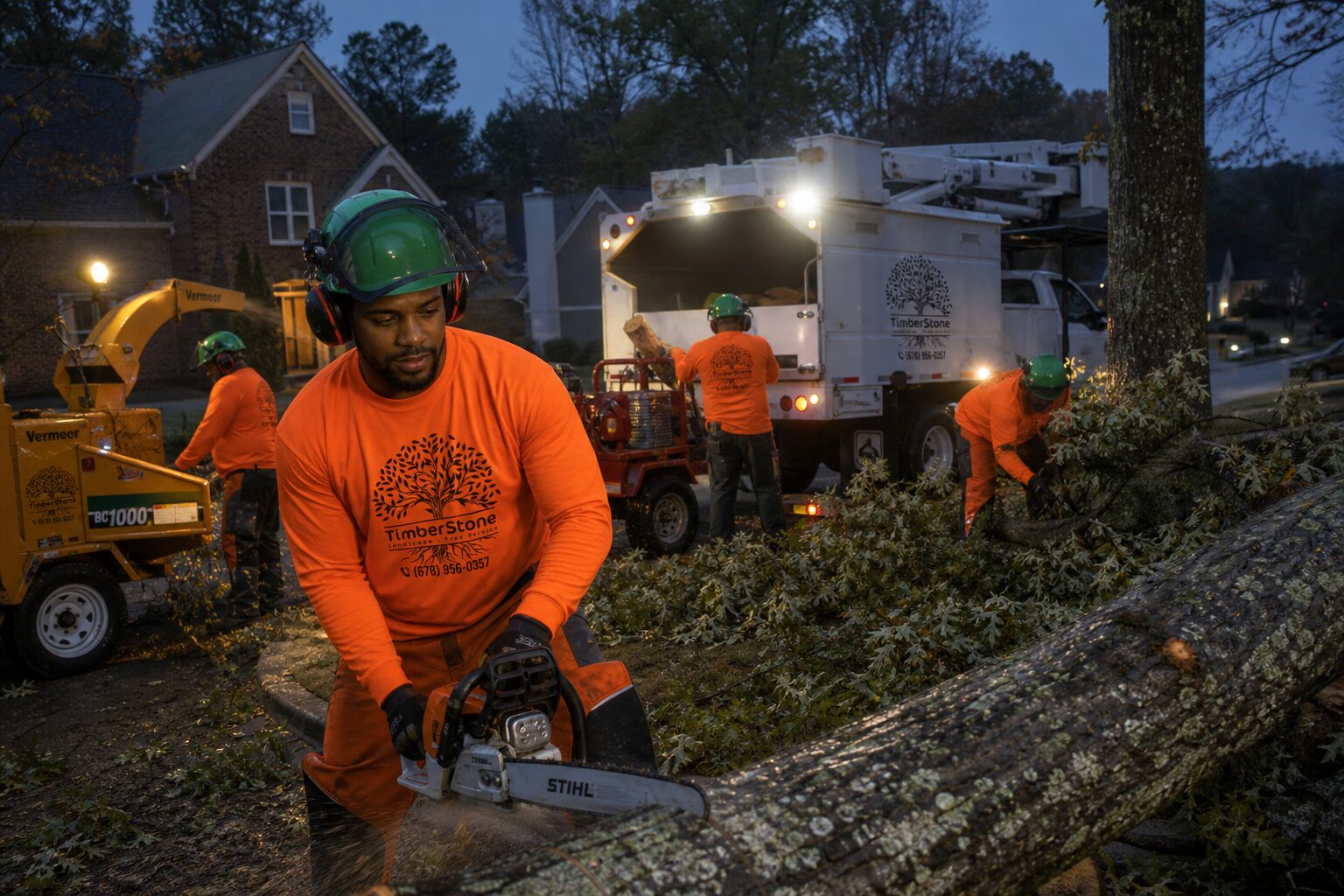
Then the part that decides whether you’d call us again: chips hauled, rounds handled the way you asked, drive blown off, beds raked. You should not be able to tell where the brush pile was.
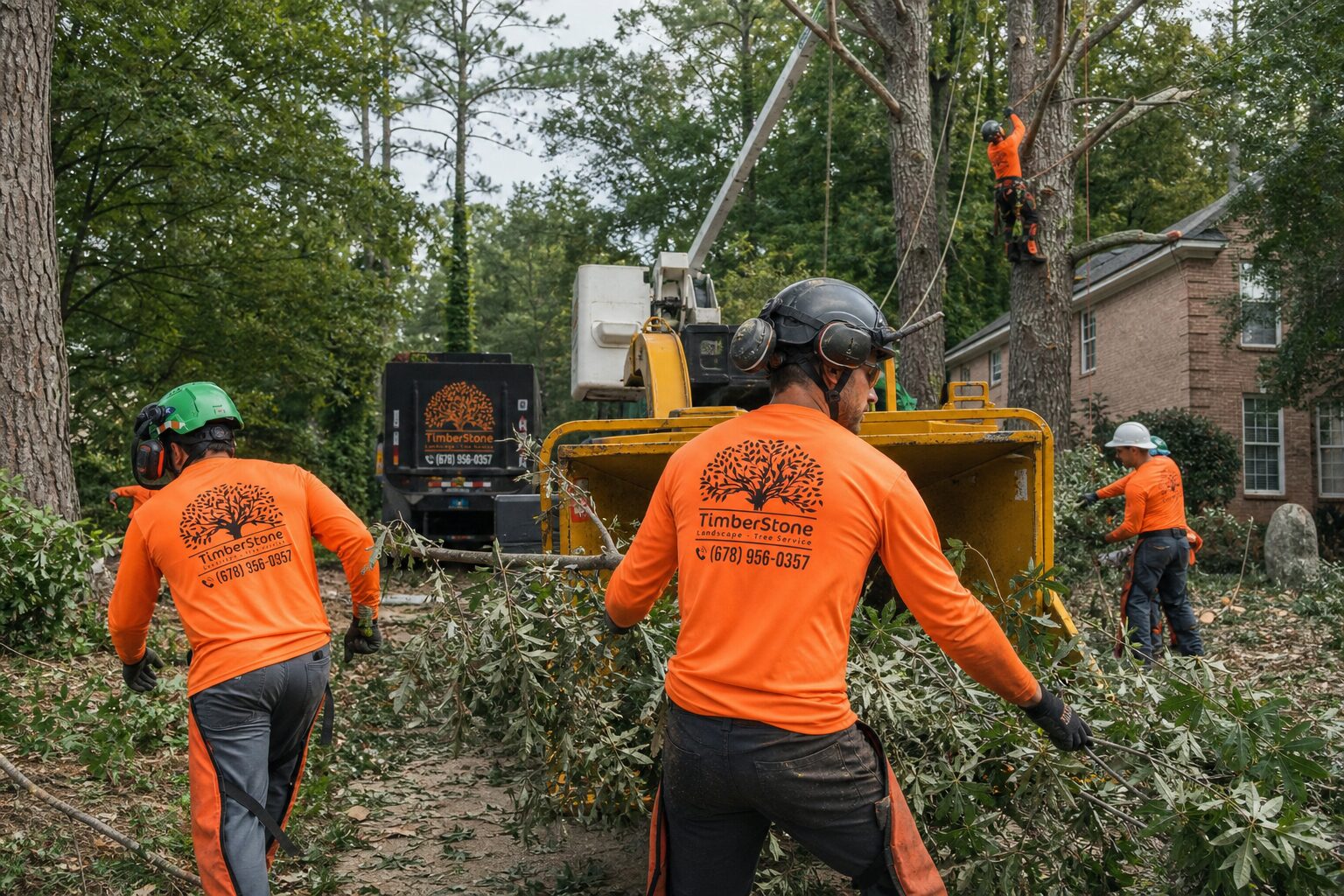
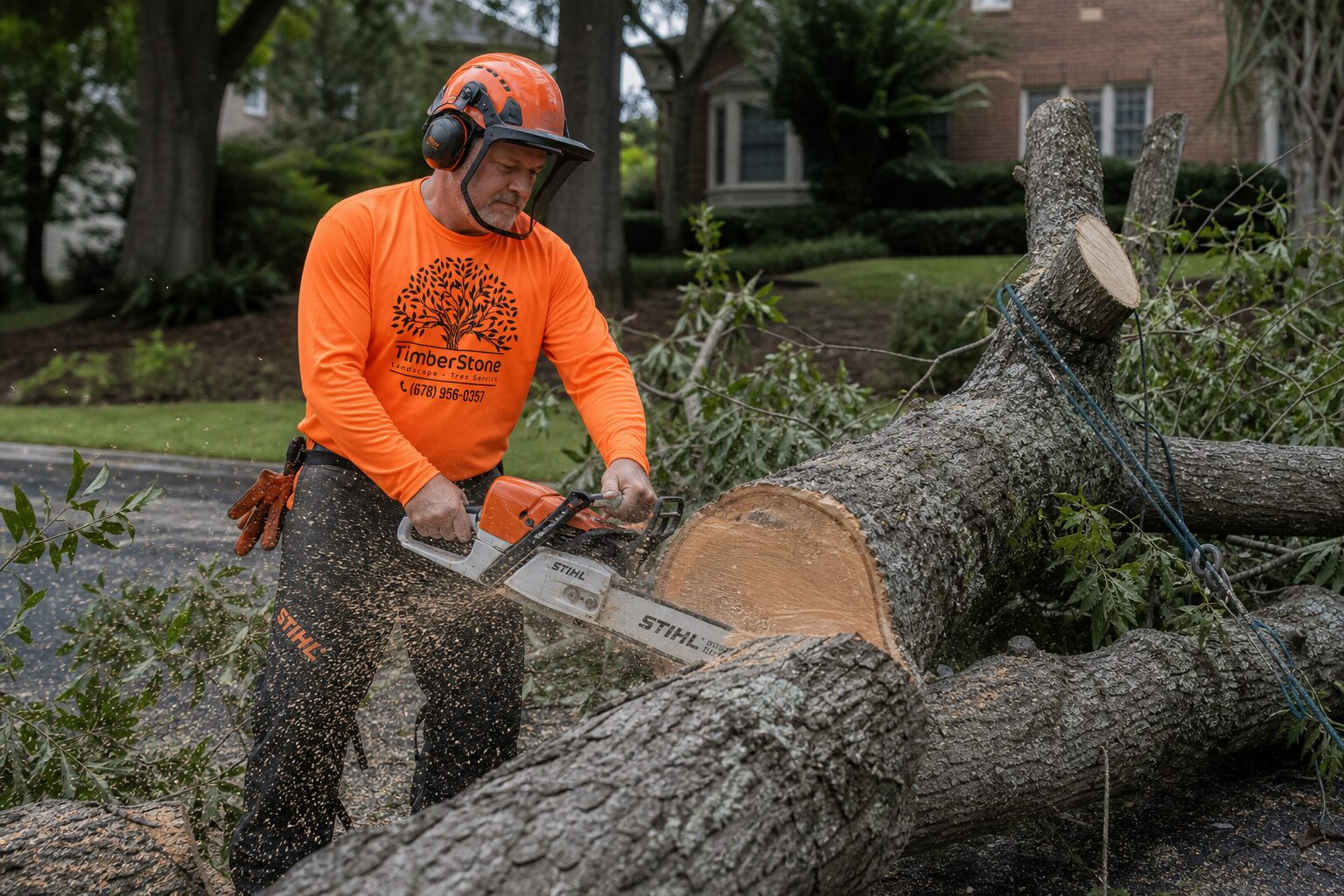
On the day, the crew arrives, protects what needs protecting, and works top down. Small limbs first to make room, then the big wood, then the stem in controlled sections. Nothing gets free-dropped near a structure.
Either way, you will know exactly what you are dealing with and what it costs before anything happens.
Good news, though. There’s a version of this that’s a lot simpler than it sounds
Here is what most homeowners never get told: the number on a quote is mostly a story about access, not about the tree. Two identical oaks, one by the driveway and one behind a fence in the back corner, are genuinely different jobs.
How the work actually goes
While the climber works, the ground crew keeps the drop zone clear and feeds the chipper. A tidy ground operation is genuinely a safety feature, not just housekeeping.
First we read the tree and the site. Where’s the lean, what’s underneath, how do we get equipment in, and where is each piece going to land. That conversation happens before anyone unloads a saw, and it’s the part that keeps your roof intact.
Then comes the setup. Mats or plywood over soft ground, protection on anything that can be scratched, and the drop zone cleared and roped off. Setup takes longer than people expect, and it’s where damage gets prevented.
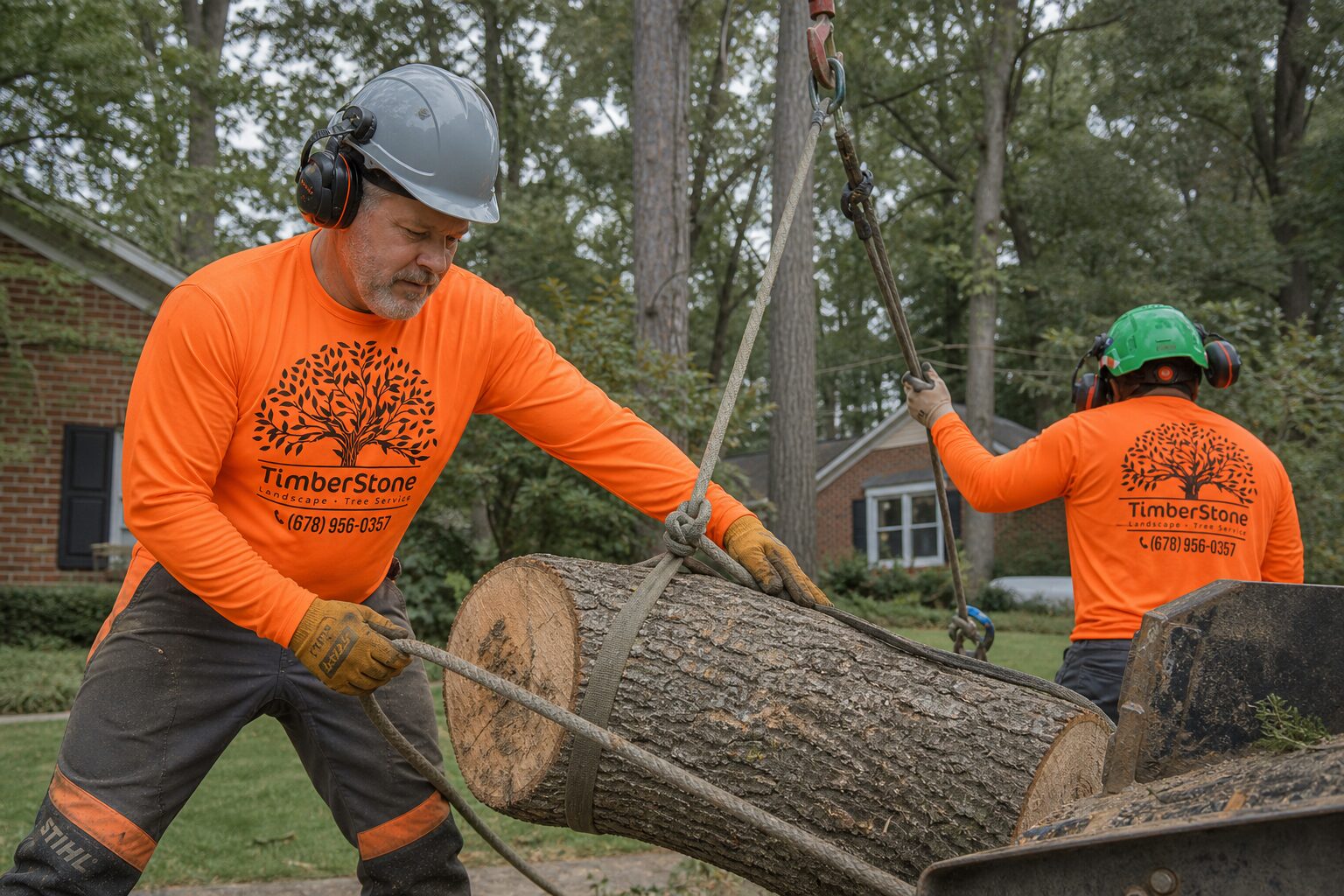
If there’s room to fell it whole, we fell it whole. Most yards don’t have room. So the tree comes apart in pieces, rigged and lowered on ropes, or picked off by crane and set down where we want it.
Why two trees the same height cost different money
Distance to the truck matters more than people expect. Every piece has to get from where it lands to where it’s loaded, and a hundred feet of carrying through a back gate adds up over a full day.
Season and ground condition shift the number too. The same job after two dry weeks and after two wet ones are not the same job, because one of them needs matting and the other doesn’t.
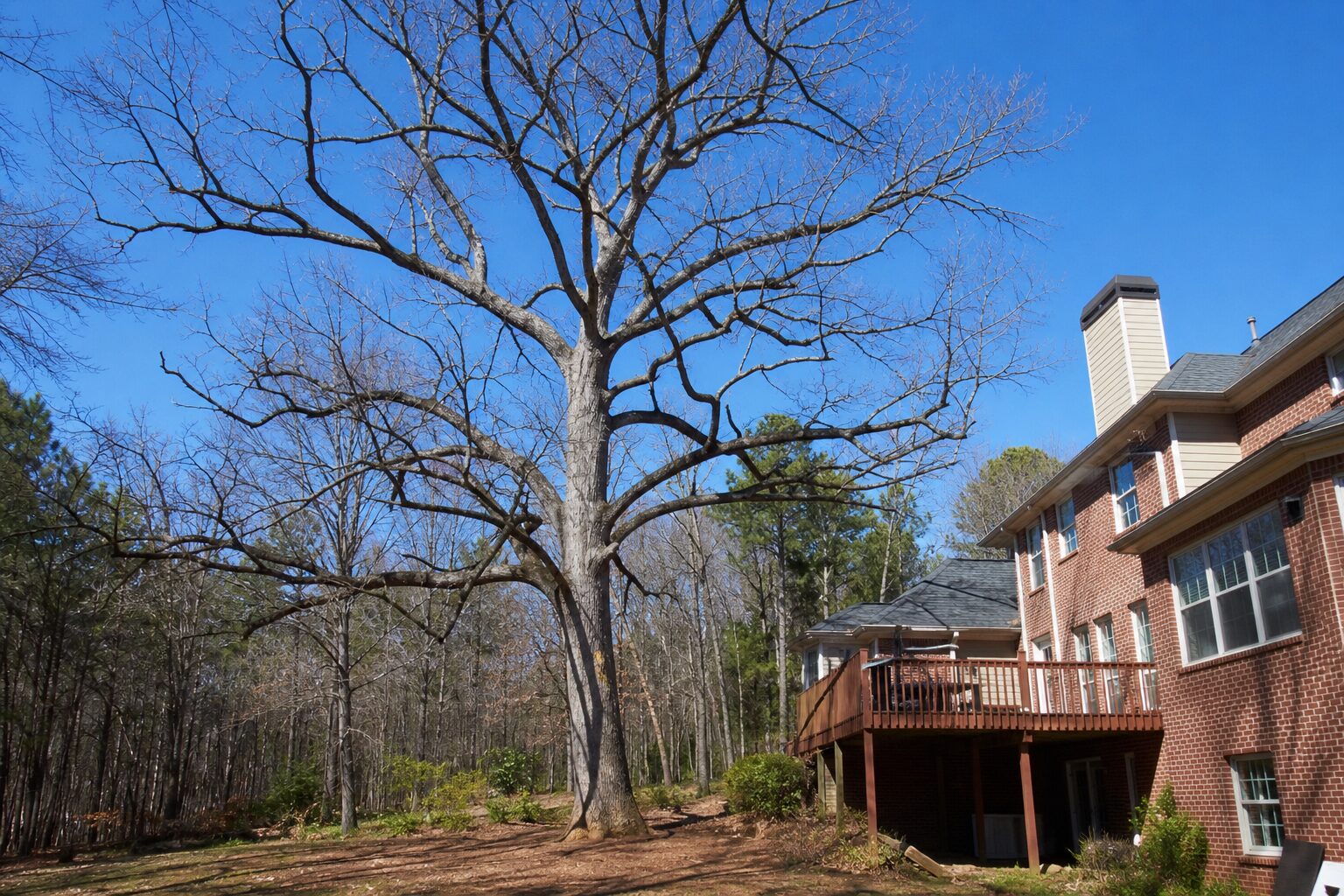
The lean matters too. A tree leaning toward the drop zone is straightforward. One leaning hard the wrong way needs rigging or a machine to pull against, and that’s more setup.
Proximity to power changes everything. Anything near a service drop needs extra care, sometimes a utility drop, and always more time. It’s not padding, it’s the difference between a safe job and a bad day.
The one question to ask any company before they set foot on the property
Ask any company this one question before they set foot on the property: how is each piece coming down? A company that has thought about the job will answer straight away, in detail. One that has not will talk about how long they have been doing this. The first answer tells you they planned it. The second tells you they did not.
While you are at it, ask for the certificate of insurance. Ask before the work, not after. Any real company sends it the same day, and Georgia Emergency Management Agency is a reasonable place to understand why that paperwork protects you and not just us.
Now, spring, or whenever?
The week after a big storm is the worst time to book non-urgent work, because every crew in the metro is triaging emergencies. Two weeks later the schedule opens right back up.
Nesting season is worth a thought on elective work. We are not required to work around it, but if a job can wait until late summer we will usually say so.
If you are selling, do it before the listing photos. Buyers read an obvious tree problem as something they will inherit, and it shows up in offers more than it should.
The advice we’d give if you weren’t paying us
Get two or three quotes, and don’t automatically take the cheapest. Ask each one how they plan to do the work and what happens to the debris. The answers separate them faster than the prices do.
Write down what you were told on the phone. If the number changes when the invoice arrives, having the original scope in writing settles it in about a minute.
Be suspicious of anyone who quotes without walking the property, and be more suspicious of anyone who knocks on your door after a storm asking for money up front.
Ask who is actually doing the work. Some outfits sell the job and subcontract it out, which is how you end up with a crew that never saw the quote you agreed to.
None of that is complicated, and none of it requires you to know anything about trees. Instead it just means asking two or three questions before the work starts rather than after, because once a crew is in your yard with a saw running your position is weaker.
How the yard feels afterward
You get your Saturday back. No brush pile to deal with, no rounds to split, no ruts to reseed. We load it, we haul it, and you walk out to a yard that looks finished.
There’s a specific relief in not having a project hanging over you. The tree stops being an item on a list you keep not getting to.
The stump goes below grade if you want it to, which means you can sod it, plant it or put a patio there. That said, the space stops being a problem and starts being usable. If you are thinking further ahead, our best tree removal Lawrenceville page covers what the rest of the property might need, and tree removal cost Snellville is useful if you are comparing options nearby.
Keep reading
Where We Work Around Lawrenceville
Where We Work Around Lawrenceville
We cover a wide stretch from the Loganville shop, and these are the communities we are in most often. Beyond Lawrenceville itself, we’re regularly out in Dacula, Snellville, Grayson, Duluth, Suwanee, Loganville, Lilburn and Buford. Same crews, same equipment, same cleanup standard, wherever the job is. And we’re proudly serving all of Metro Atlanta from the same shop, so if you’re just outside that list, still call. For the service overview, see tree removal in Lawrenceville.
Questions We Get About Tree Removal in Lawrenceville
What about my lawn and driveway?
That’s the question we get most. We plan the machine route before we start, put mats or plywood down on soft ground, and pick equipment that fits the yard instead of the biggest thing on the trailer.
Are you licensed and insured?
Yes. Ask for the certificate of insurance and we’ll send it before the crew rolls, not after something goes wrong. It’s a fair thing to ask any company, and a company that dodges the question is telling you something.
What happens to the wood?
Chipped and hauled by default. If you want the rounds for firewood we’ll cut them to length and stack them, and if you want the chips for mulch we’ll spread them instead of taking them.
Can you give me a price over the phone?
We can give you a range once we understand the tree, but a real number needs eyes on it. Size, lean, access, what’s underneath and cleanup all move the price, so we come look first. That look is free.
Is there a bad time of year to do this?
Not really for removal. Late winter is easiest because the structure is visible and the ground is firm, but we work year round. Wet ground is the only thing that genuinely changes our plan.
Do you handle the permit if one is needed?
It depends on the city and whether the tree is protected or in a buffer. We’ll tell you what we know and point you at the right office, but confirm it with them rather than with us.
Got a tree in Lawrenceville you’re not sure about?
Same-day answers on anything that looks urgent.
(678) 956-0357