
When Tree Removal Near House in Alpharetta Becomes Urgent
The worry is obvious and reasonable: that a piece of this tree ends up through the roof during the removal rather than during a storm. If you are weighing up tree removal near house Alpharetta right now, this covers how a tree comes down when there is nowhere to drop it, when a crane earns its keep, and what protects the house while we work.
Here is the honest answer up front. tree removal near house Alpharetta is slower and costs more than a straightforward fell, and it is the only way to do it without damage.
What we run into around Alpharetta specifically
Tall loblolly pines left standing in tight groups through 1980s-90s development, with a floodplain running through the middle of town That shapes almost everything about how a job gets planned here.
- Bradford pears line entire 1990s streets here and are hitting the age where they split
- Windward’s pine stands are the signature problem. Tall, skinny loblollies planted or retained in tight groups, shallow-rooted in clay, with nothing around them to break the wind. When one goes, it often takes a neighbor with it. Thinning and hazard removal in these back lots is steady work
- Big Creek floodplain runs through the middle of the city along the greenway. Properties near it have saturated soil year-round and the uprooting risk that comes with it
- Downtown and Crabapple legacy trees are the delicate jobs — huge old oaks a few feet from historic structures, tight access, no room to drop anything. This is crane and rigging work and it’s premium
So when we are out around downtown Alpharetta, Country Club of the South and Hopewell Plantation, those are the first things we check. If you are anywhere near Webb Bridge Park and downtown Alpharetta City Center, or off Old Milton Parkway, you are well inside our normal run.
~65,000 residents. Median household income well into six figures. A major corporate employment center — the “Technology City of the South” nickname is used locally and it’s earned; a huge share of residents work within a few miles rather than commuting downtown. Housing runs 1985–2005 in the subdivisions, with a genuinely historic core downtown and around Crabapple, plus a large wave of new high-density infill since 2015
Most competitive market in the radius — win on professionalism, not price GA-400 is “four-hundred” and it’s the spine of the city Windward + Lake Windward is the anchor community — tall pine stands, tight spacing, wind failures
“Four-hundred” for GA-400 — always. “Avalon” needs no explanation. “Downtown Alpharetta” means the City Center district. “Crabapple” is its own identity and residents there say Crabapple, not Alpharetta. “Windward” is a place, not just a road. People here say “North Fulton” as a regional identity That matters more than it sounds, because when somebody calls and says which side of town they are on, we already know the access and the tree cover before we get there.
Spring storms bring the Windward pine failures. Summer microbursts off Big Creek. Dormant-season structural pruning is an easy sell here because this homeowner plans and budgets. Post-holiday and early-spring is when they book the “get the yard right before summer” work Because of that, the same tree can be a straightforward morning in one month and a genuinely awkward job in another, and we would rather tell you that up front than discover it with a machine already on your lawn. For the wider picture on tree condition and care in this region, Georgia Forestry Commission publishes solid homeowner guidance.
Improvisation is the expensive option
We also price honestly between methods. Sometimes a crane is genuinely cheaper because the job takes a third of the time, and we will tell you when that is the case.
Protection should be part of the answer too. Plywood and mats over hardscape, covers on pool coping, and a cleared staging area are all things that get named in advance. That is also why we put the reasoning in writing. You can read what we are seeing and decide for yourself, instead of taking our word for it. If you want the longer breakdown, we walk through it on our crane vs climbing removal Alpharetta page.
A low quote on a tight tree usually means the rigging hasn’t been planned.
Working over a roof safely
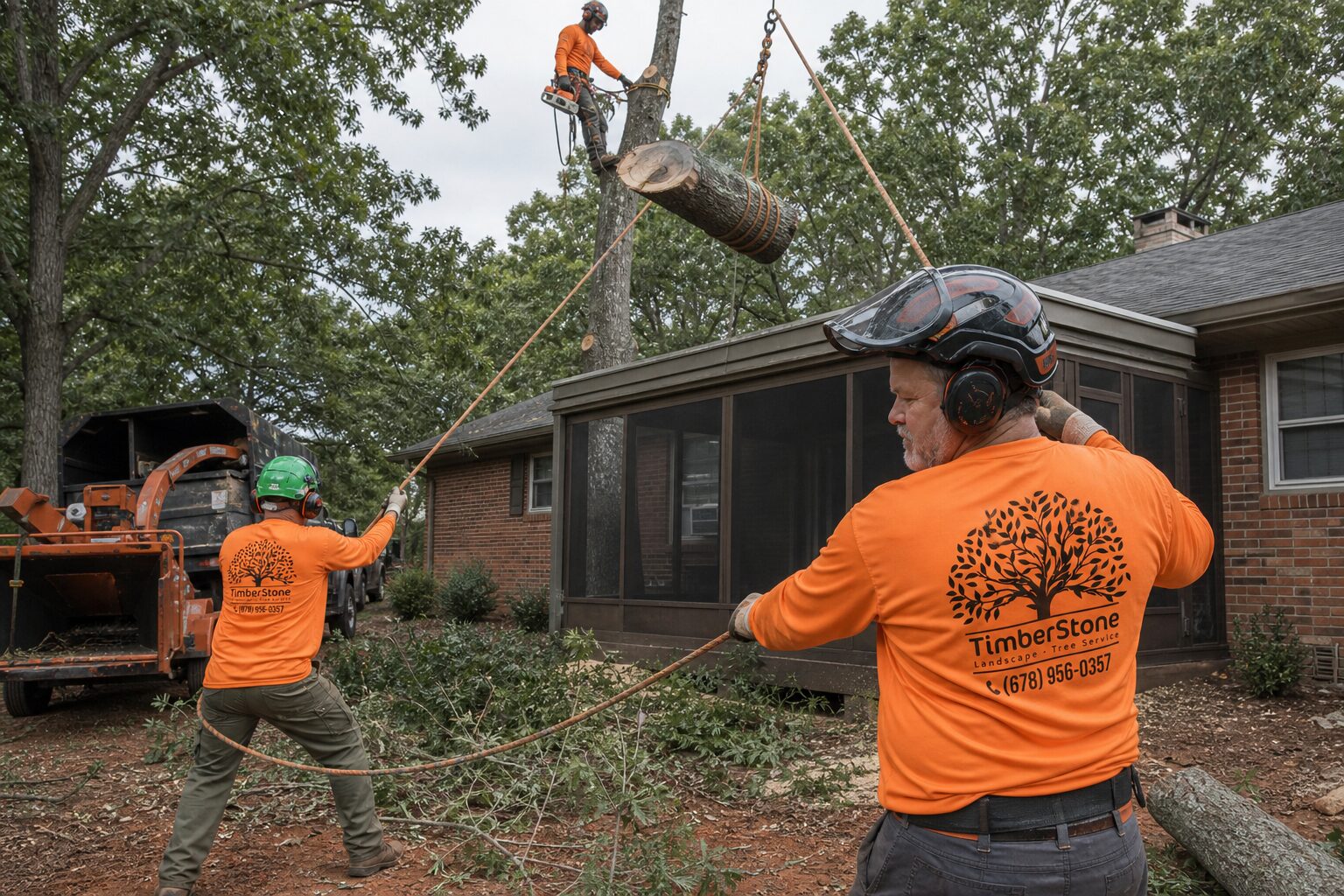
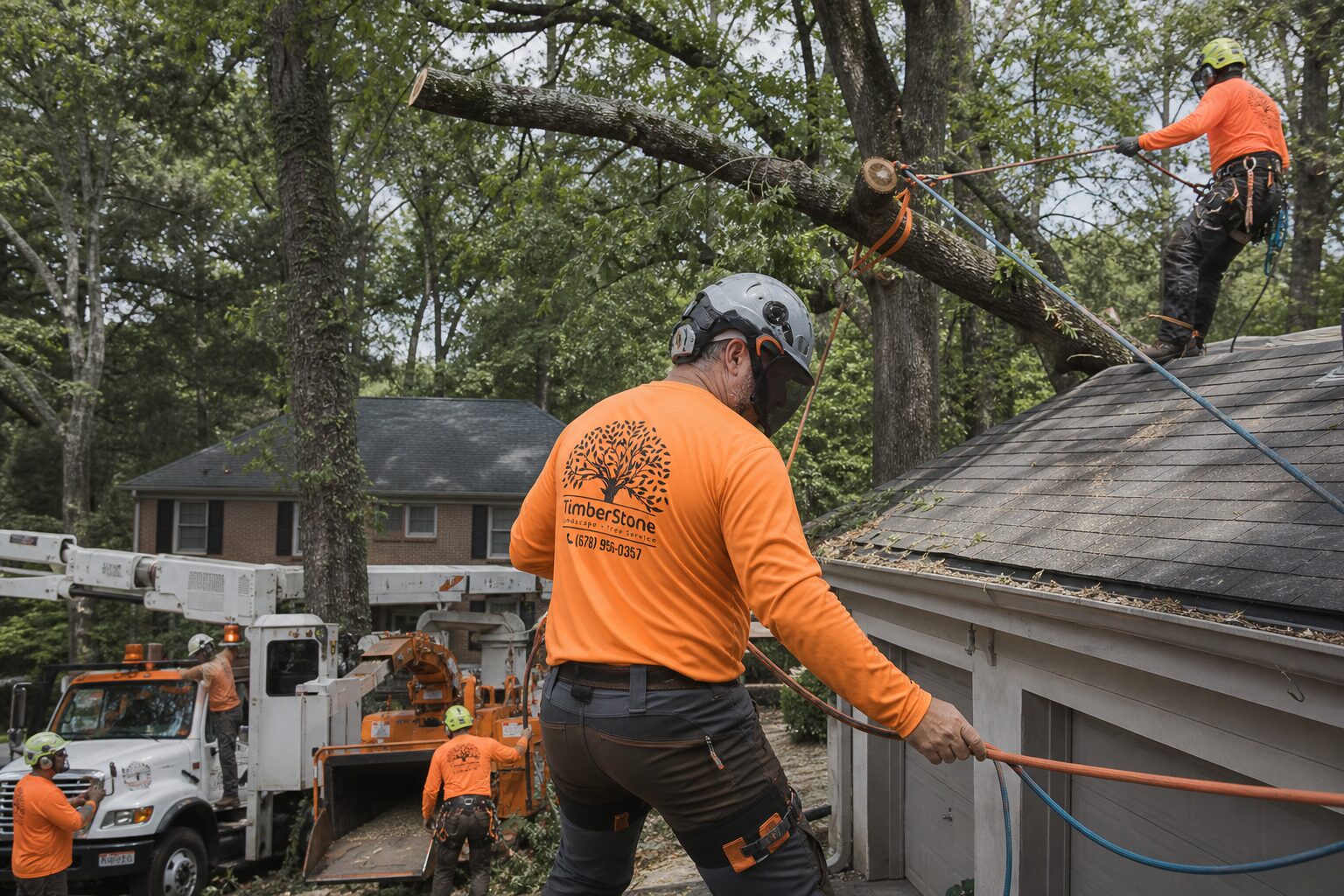
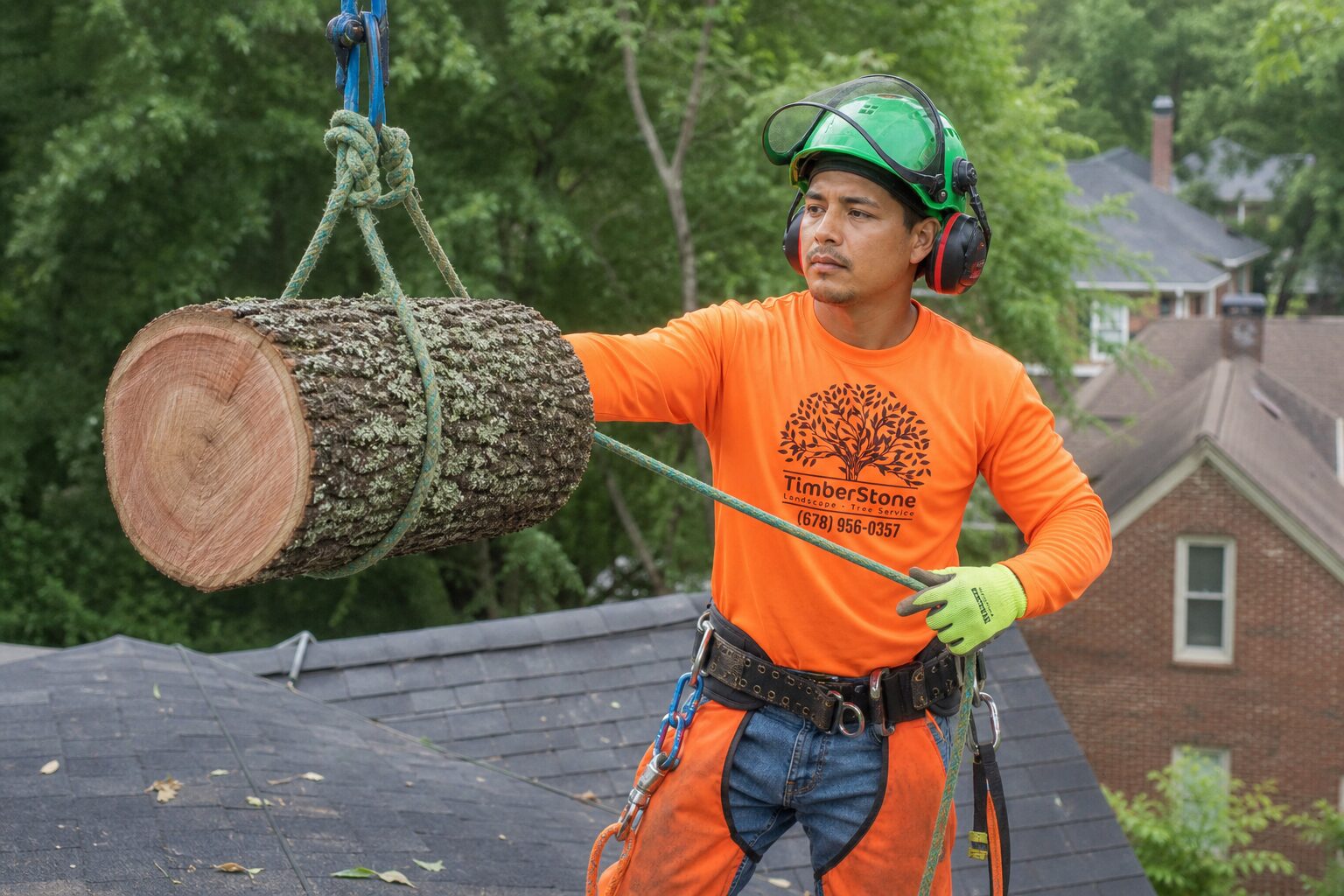
A tree hard against a house is not primarily a size problem, it is a control problem. Every piece has to be held before it is cut and lowered rather than dropped.
And the last few metres of stem come down in short sections, cut and dropped straight into a cleared area rather than felled in any direction.
Where the stem is decayed, the plan gets more conservative again, because you cannot hang rigging loads off wood you do not trust.
Piece size gets reduced near the structure. Smaller pieces mean more cuts and more time, and they also mean nothing heavy is ever moving near the wall.
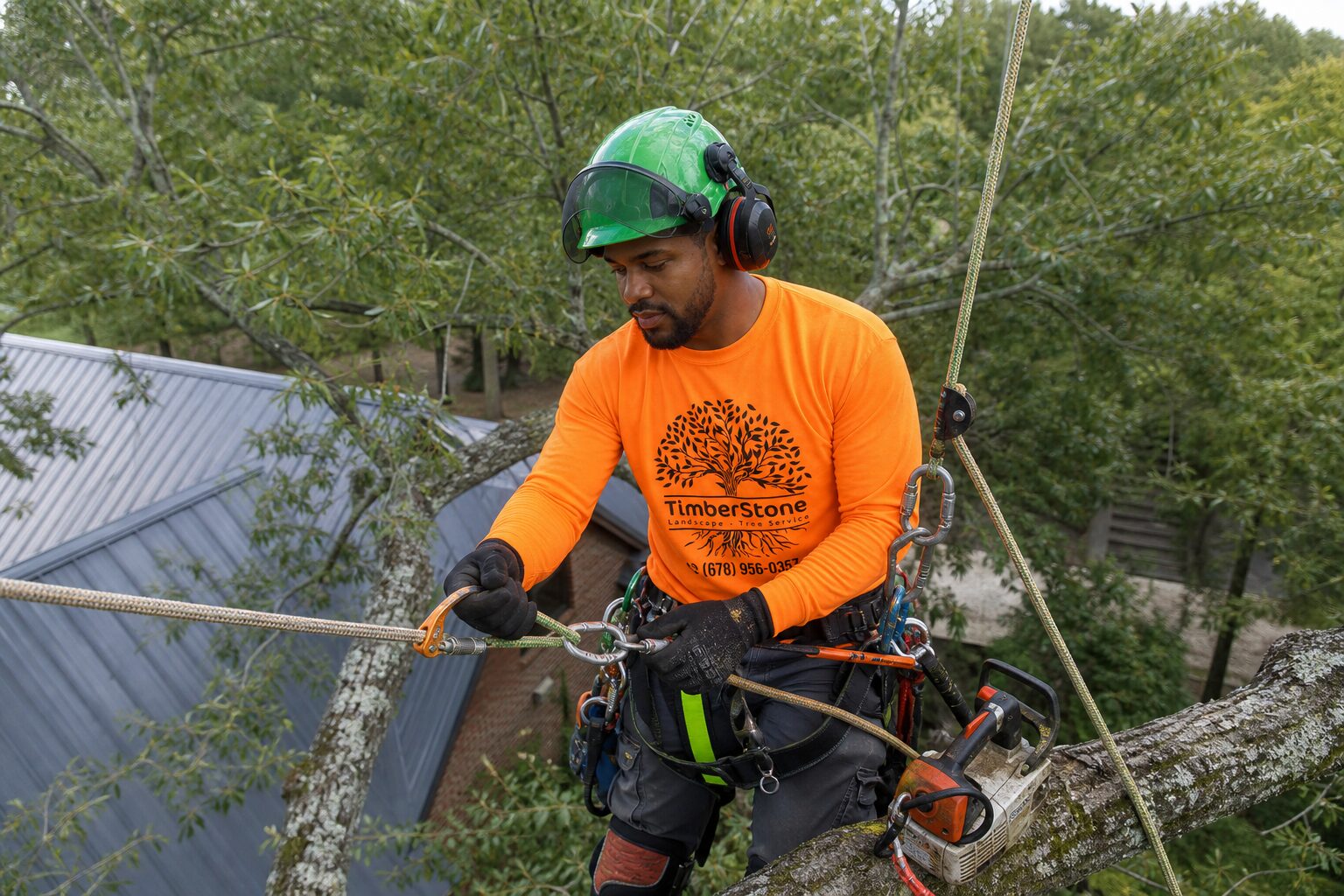
Rigging points are chosen inside the tree so that pieces swing away from the building rather than toward it as they come free.
And then it is off your list, which is most of what people are really buying.
But here’s what most people get wrong about this
Here is what most homeowners never get told: the number on a quote is mostly a story about access, not about the tree. Two identical oaks, one by the driveway and one behind a fence in the back corner, are genuinely different jobs.
What has to be controlled, and why
And the neighbour’s property is frequently the best setup position, which is a conversation to have before the day rather than on it.
Condition compounds all of it. A decayed stem cannot be trusted to take rigging loads, so the plan gets more conservative and often more expensive. Because of that, we always start at the base and work up, rather than starting with the part of the tree you can see from the kitchen window.
Trees between houses are their own category. Eight feet of daylight either side means every piece is a controlled lower, and there is no margin for a swing.
The reassuring part is that a well-planned technical removal is genuinely low risk. The danger comes from improvisation, not from difficulty.
Preparing for a near-structure removal
- Check for overhead service drops and tell the company about them.
- Ask exactly how each piece is coming down.
- Ask what gets protected, and how, before cutting starts.
- Confirm whether a crane is needed and why, or why not.
- Check whether access to a neighbour’s property is required.
- Confirm the certificate of insurance covers work over a structure.
If two or more of those are true, it is worth having somebody look. But if none of them are, the tree is probably fine and you can stop thinking about it.
A story about a neighbor with the exact same problem and how it turned out
Ask any company this one question before they set foot on the property: how is each piece coming down? A company that has thought about the job will answer straight away, in detail. One that has not will talk about how long they have been doing this. The first answer tells you they planned it. The second tells you they did not.
While you are at it, ask for the certificate of insurance. Ask before the work, not after. Any real company sends it the same day, and Georgia Power is a reasonable place to understand why that paperwork protects you and not just us.
What we get called in to undo
Hiring someone with the wrong equipment for the access you have. The right machine for a tight back yard is not the biggest one on the trailer, and forcing it is how lawns get destroyed.
Paying a large deposit up front is another. A real company does not need most of the money before the work starts, and the outfits that do are frequently gone afterward.
And letting work start before you have seen proof of insurance, which is the one mistake on this list you genuinely cannot fix afterward.
Assuming the cheapest quote covers the same work is the quiet one. Read what is actually in each scope. Half the price difference between two quotes is usually just debris removal.
Now, spring, or whenever?
Late winter is the easiest window for most tree work. The leaves are off, so the structure is visible, the ground is usually firm enough for equipment, and the trees are dormant.
Storm season is the one time we genuinely get backed up. Getting known work on the schedule before severe weather means you are not waiting behind emergencies.
The week after a big storm is the worst time to book non-urgent work, because every crew in the metro is triaging emergencies. Two weeks later the schedule opens right back up.
Sorting genuine risk from proximity
Where a tree is genuinely borderline, get it assessed and documented rather than guessing. That record is useful for insurers later.
If the tree is healthy but the limbs are on the roof, that is a pruning job rather than a removal, and it costs a fraction as much.
Close is not the same as dangerous. A sound tree three metres from a wall with no defects is generally fine and does not need removing.
The sequence, piece by piece
Protection goes down before anything is cut. Plywood and mats over driveways and patios, covers on pool coping, and the drop zone cleared of anything moveable.
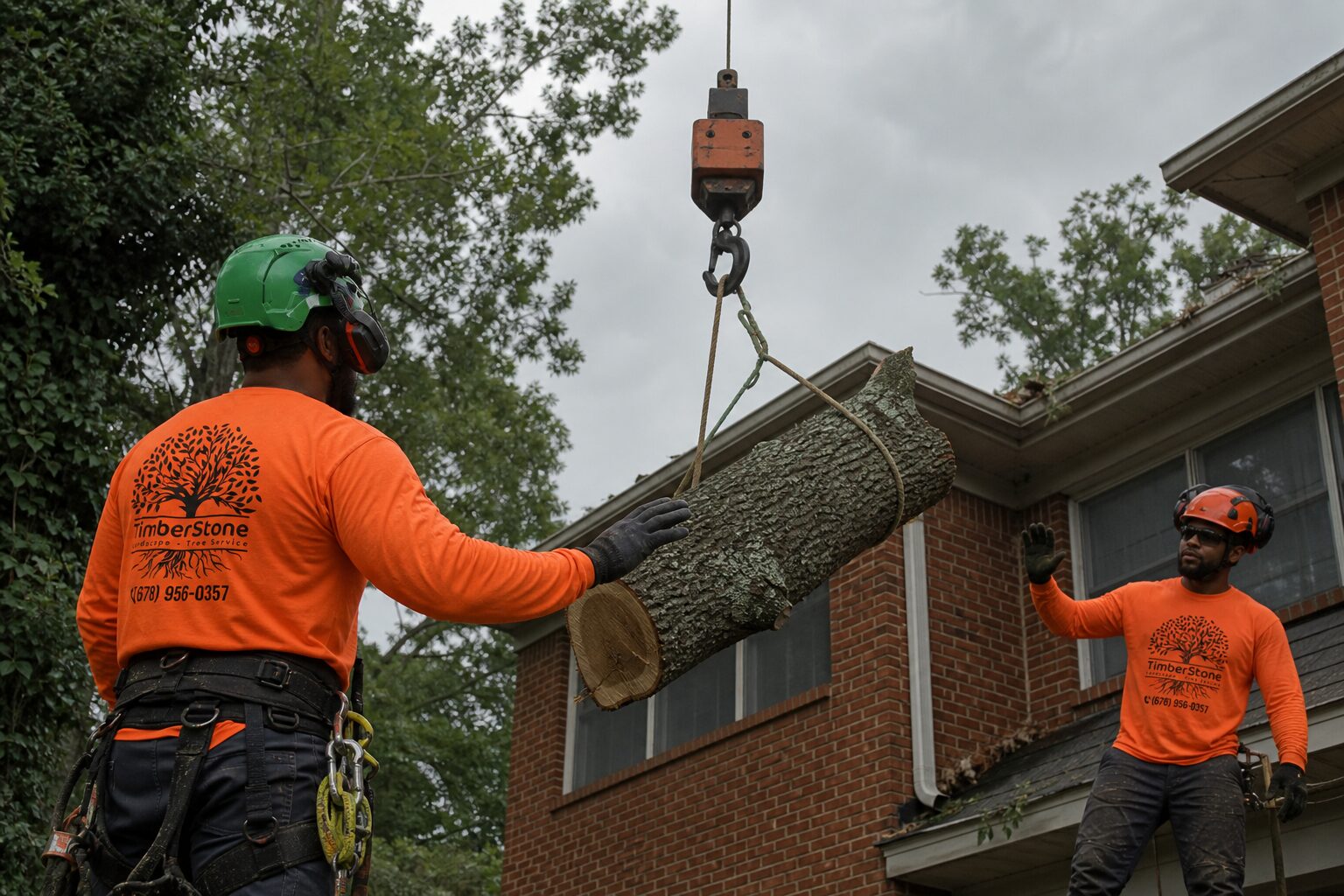
Every piece near a structure is tied before it is cut. Cut, take the weight, lower on the friction device, untie, clear, repeat. That rhythm is the whole job.
Then protection comes up, debris goes out, and the property gets raked and blown before anybody leaves.
If a crane is being used, it sets up and gets tested with a light pick before anything serious is lifted. Outrigger pads go on firm ground, and swing radius is checked against everything overhead.
The house afterward
And the risk that had you worried every time the wind picked up is simply no longer there.
The tree is gone and the house has not got a mark on it, which on a genuinely tight removal is the entire measure of success.
The hardscape is intact because it was covered before anybody started, not because everyone was careful around it. If you are thinking further ahead, our crane tree removal Alpharetta page covers what the rest of the property might need, and tight access tree removal Tucker is useful if you are comparing options nearby.
Keep reading
Where We Work Around Alpharetta
Where We Work Around Alpharetta
We cover a wide stretch from the Loganville shop, and these are the communities we are in most often. Beyond Alpharetta itself, we’re regularly out in Milton, Johns Creek, Roswell, Cumming, Duluth, Suwanee, Woodstock and Sandy Springs. Same crews, same equipment, same cleanup standard, wherever the job is. And we’re proudly serving all of Metro Atlanta from the same shop, so if you’re just outside that list, still call. For the service overview, see technical & near-structure removal in Alpharetta.
Questions We Get About Crane & Technical Removal in Alpharetta
How do you protect the driveway and lawn?
Plywood and matting under machine routes and outriggers, and covers over anything that chips. It goes down before cutting starts, which is the point.
Why is the quote so much higher than for a tree in the open?
Because the price tracks controlled pieces rather than tree size. A tree that can be felled whole takes minutes; the same tree lowered piece by piece past a conservatory takes a day.
What if the tree is over my pool?
Then nothing gets free-dropped. Pieces are rigged and swung clear, and we cover the tile and coping before we start. Pools need more protection than roofs, not less.
Can you remove a tree from a back garden with no vehicle access?
Usually yes. Small tracked machines get through standard gates, and where nothing fits, a crane over the house is sometimes the cheapest way in.
Do I always need a crane?
No. Most near-structure removals are done on rigging lines from a climber or a bucket. A crane is for trees where reach or weight makes rigging slow or unsafe, and it is often about speed rather than possibility.
Do you need access to my neighbour’s yard?
Sometimes it is the safest setup. We will ask you first, and we are happy to speak to the neighbour ourselves if that makes the conversation easier.
Got a tree in Alpharetta you’re not sure about?
Free quote, no pressure – we’ll tell you if it can wait.
(678) 956-0357