
Insurance Tree Removal in Watkinsville: Red Flags to Watch
“Does insurance cover tree removal?” Sometimes, and it turns almost entirely on what the tree hit. If you are weighing up insurance tree removal Watkinsville right now, this explains what actually drives the number, how to read a quote, and where insurance does and does not come into it.
Here is the honest answer up front. We will not publish a price list for insurance tree removal Watkinsville, because a number without seeing the tree would be a made-up number.
What we run into around Watkinsville specifically
Acreage country with legacy pecans and open-grown white oaks, plus 19th-century homes downtown under trees older than the houses That shapes almost everything about how a job gets planned here.
- Acreage means access problems: long gravel drives, culverts with weight limits, gates, pastures you can’t rut
- Wind exposure on open land is high; there’s no neighboring canopy to break it
- Genuinely historic trees in downtown Watkinsville, inches from 19th-century structures. Delicate, high-consequence, crane-and-rigging work
- Overgrown fence rows and reclaimed pasture — a real land-clearing service line out here
So when we are out around Butler’s Crossing, Lane Creek and Rocky Branch, those are the first things we check. If you are anywhere near the Oconee River and the Eagle Tavern Museum, or off GA-15, you are well inside our normal run.
this is acreage country. Two, five and ten-acre lots with long driveways, pastures, ponds, barns and genuinely old trees. There’s also a historic in-town core in Watkinsville with 19th-century homes under enormous legacy hardwoods, plus newer executive subdivisions along Mars Hill catering to Athens professionals
Referral-driven community — one bad job travels fast, one good one travels further Say Oconee — it’s the identity. Watkinsville is the county seat and the downtown Among the highest-income, highest-educated counties in Georgia
“Oconee” is the identity — people say “we’re in Oconee,” not “we’re in Watkinsville,” unless they live in town. “Butler’s Crossing” is the intersection everyone navigates by. “441” is the main road. “Athens” is the reference point for everything. Residents are conscious of being not Athens-Clarke and are proud of Oconee’s schools. “Downtown” means the small Watkinsville arts district That matters more than it sounds, because when somebody calls and says which side of town they are on, we already know the access and the tree cover before we get there.
Spring severe season on exposed open land. Summer limb drop on pecans and old oaks. Fall is pecan harvest season — homeowners are under the trees and notice deadwood. Winter is the right window for structural pruning and pasture/fence-row clearing Because of that, the same tree can be a straightforward morning in one month and a genuinely awkward job in another, and we would rather tell you that up front than discover it with a machine already on your lawn. For the wider picture on tree condition and care in this region, OSHA publishes solid homeowner guidance.
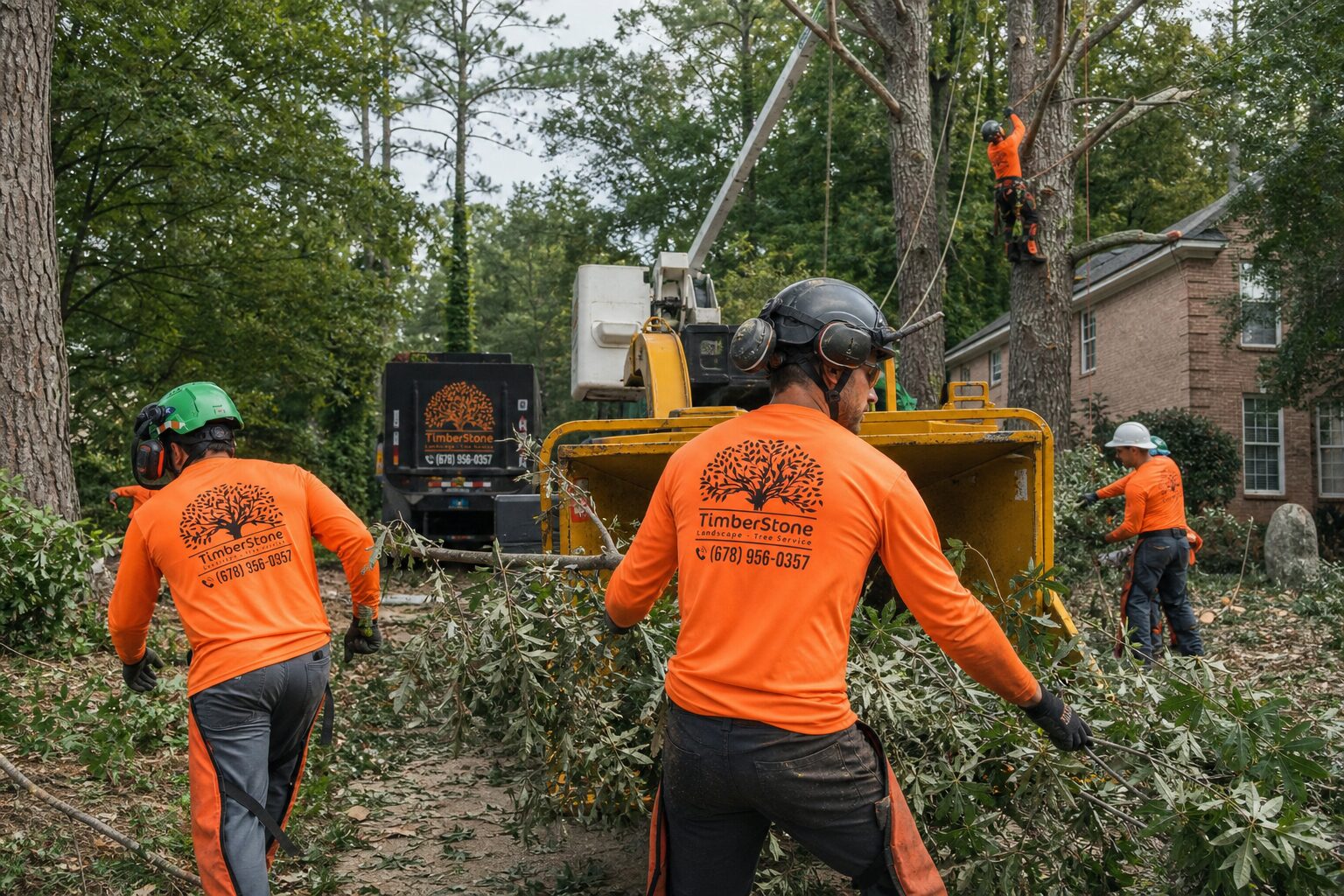
The second invoice, and how to avoid it
We put exclusions in writing as well as inclusions, because the second invoice is the single most common complaint in this trade and it is entirely avoidable.
Some of it is also insurance. An uninsured crew genuinely can charge less, right up until something goes wrong on your property and you are the one holding it. That is also why we put the reasoning in writing. You can read what we are seeing and decide for yourself, instead of taking our word for it. If you want the longer breakdown, we walk through it on our tree service cost Watkinsville page.
Ask what is excluded. That is where the second invoice comes from.
Documentation your adjuster will want
Insurance generally responds to damage rather than to trees. A healthy tree that falls and hits nothing is usually your problem and your cost.
We do not file claims and we are not adjusters. Ask your insurer the specifics, and treat anyone promising to handle your claim for you with real caution.
Whatever the situation, photograph everything before it moves, note the time, and open the claim before cleanup starts. We document the work as we go for exactly this reason.
Neighbour trees usually run through your own policy when they land on your property, though it varies by policy and by whether the tree was known to be dangerous.
A tree that was visibly dead or defective beforehand can complicate a claim, because insurers may treat known hazards as maintenance rather than sudden loss. That is one reason documented assessments matter.
That is the whole point: you go into it knowing the plan instead of hoping for one.
So why does the same job cost two different numbers? Here’s the honest reason
Here is what most homeowners never get told: the number on a quote is mostly a story about access, not about the tree. Two identical oaks, one by the driveway and one behind a fence in the back corner, are genuinely different jobs.
What a quote should tell you
And ask for it in writing. A verbal number is not a scope, and it settles nothing when the work turns out bigger than expected.
Lean matters. A tree leaning toward the drop zone is straightforward. One leaning hard the wrong way needs rigging or a machine to pull against it. Because of that, we always start at the base and work up, rather than starting with the part of the tree you can see from the kitchen window.
Then there is the crew. Insured, trained and equipped costs more per hour than a truck and a saw, and that difference is the thing you are actually buying.
The reassuring part is that the estimate itself is free, so getting a real number costs you nothing but an hour.
Is this urgent, or is this a spring project?
Late winter is the easiest window for most tree work. The leaves are off, so the structure is visible, the ground is usually firm enough for equipment, and the trees are dormant.
Nesting season is worth a thought on elective work. We are not required to work around it, but if a job can wait until late summer we will usually say so.
Wet ground changes our plan more than cold does. After a long stretch of rain the clay here holds water, and driving a machine over saturated ground is how lawns get wrecked. We would rather push a week.
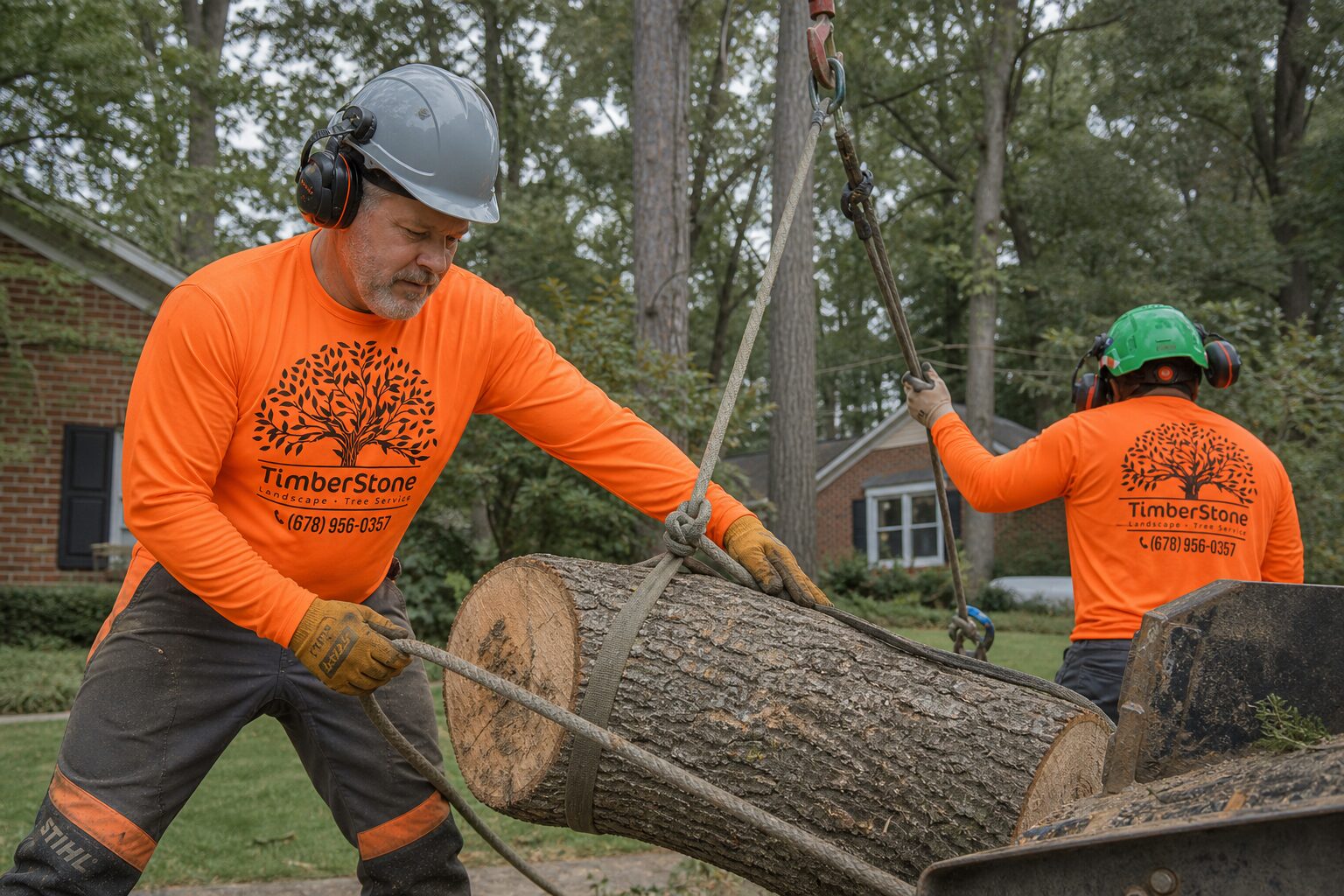
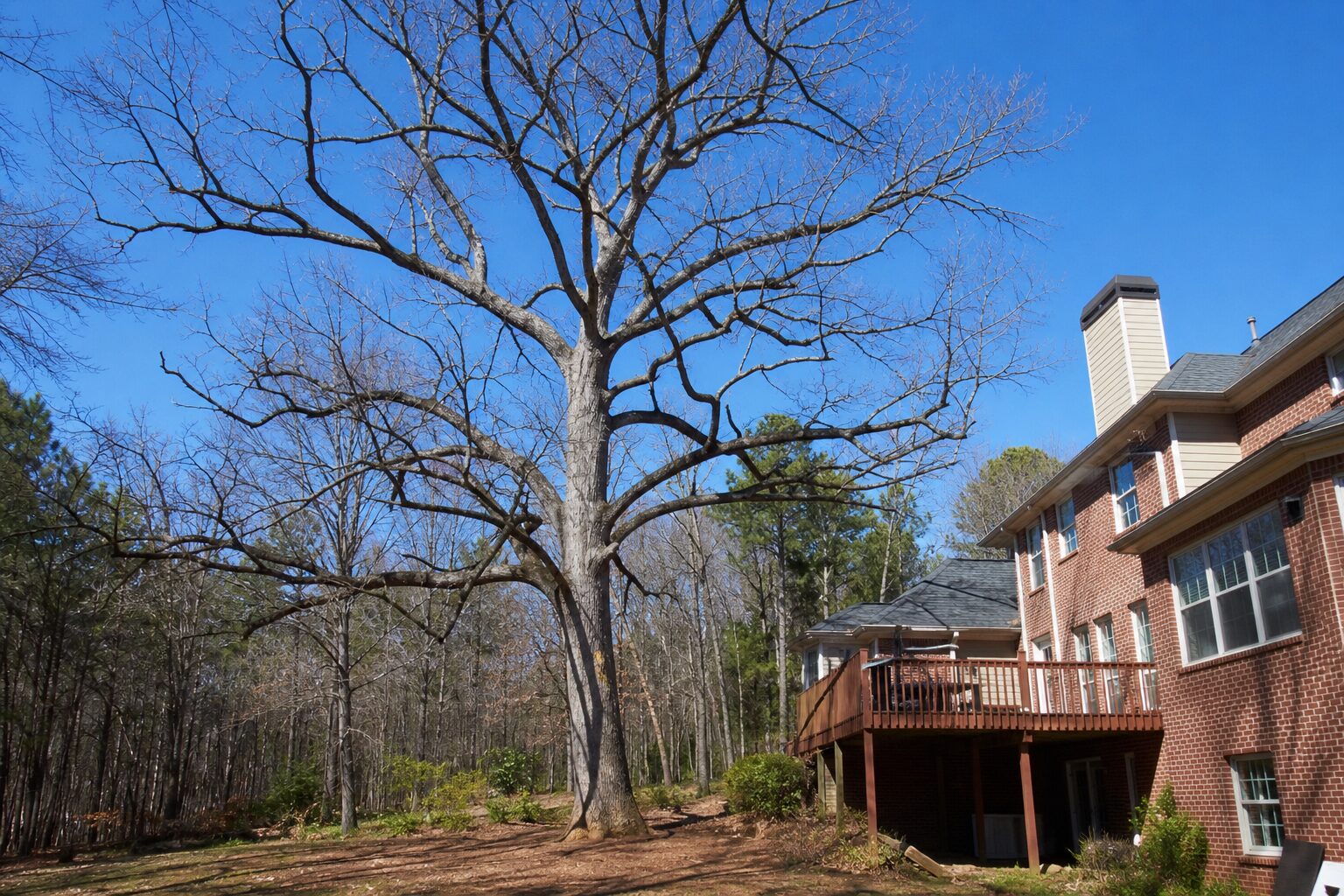
What changes about this once you understand how the soil here behaves
Ask any company this one question before they set foot on the property: how is each piece coming down? A company that has thought about the job will answer straight away, in detail. One that has not will talk about how long they have been doing this. The first answer tells you they planned it. The second tells you they did not.
While you are at it, ask for the certificate of insurance. Ask before the work, not after. Any real company sends it the same day, and USDA Forest Service is a reasonable place to understand why that paperwork protects you and not just us.
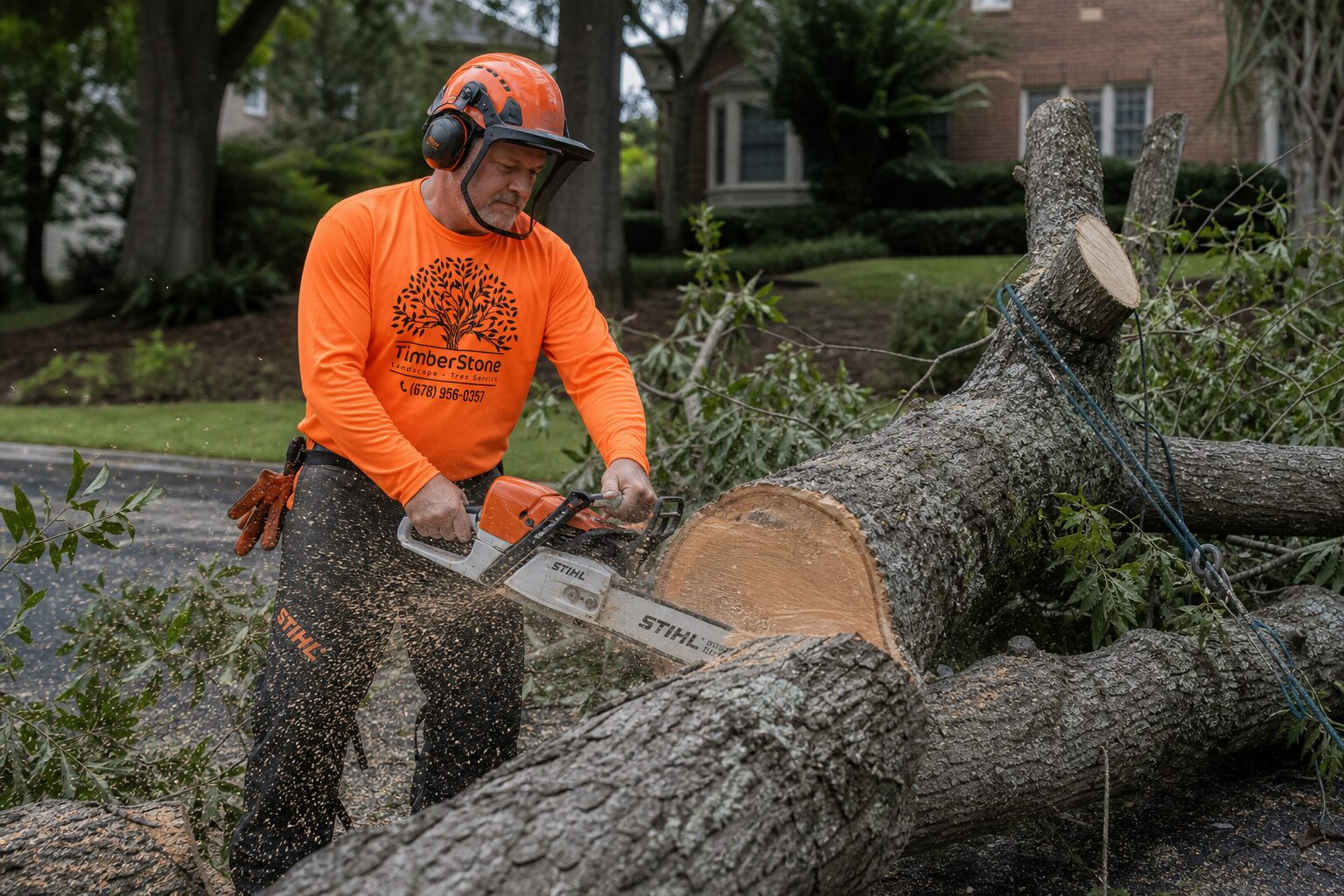
The advice we’d give if you weren’t paying us
Be suspicious of anyone who quotes without walking the property, and be more suspicious of anyone who knocks on your door after a storm asking for money up front.
Write down what you were told on the phone. If the number changes when the invoice arrives, having the original scope in writing settles it in about a minute.
Get two or three quotes, and don’t automatically take the cheapest. Ask each one how they plan to do the work and what happens to the debris. The answers separate them faster than the prices do.
Take photos of the yard before the crew arrives. Not because we expect trouble, but because it makes any conversation afterward simple and factual for everyone.
None of that is complicated, and none of it requires you to know anything about trees. Instead it just means asking two or three questions before the work starts rather than after, because once a crew is in your yard with a saw running your position is weaker.
The mistakes that cost people the most
Hiring someone with the wrong equipment for the access you have. The right machine for a tight back yard is not the biggest one on the trailer, and forcing it is how lawns get destroyed.
Assuming the cheapest quote covers the same work is the quiet one. Read what is actually in each scope. Half the price difference between two quotes is usually just debris removal.
Letting a crew work without agreeing cleanup in advance is how people end up with debris across the lawn and a bill that says haul-off, additional.
Paying a large deposit up front is another. A real company does not need most of the money before the work starts, and the outfits that do are frequently gone afterward.
Inside an estimate
Then we come out. Photos help but they flatten distance and hide access, and access is usually the biggest single factor in the price.
It starts on the phone. Species, rough size, what is near it and what you want done afterward gets us most of the way to knowing what kind of job this is.
If we think the work can wait or a smaller job would do, we say so at that point rather than after we have your signature.
There is no charge and no obligation, and we are happy to be one of three quotes. Being compared is fine when your scope is honest.
The five drivers, in order
Size and species next. Height and diameter drive the material volume, and dense hardwood is slower to cut and heavier to move than pine.
Then targets. Anything that cannot be dropped has to be rigged and lowered piece by piece, and on a tree over a conservatory that is most of the day.
Access first. It is the factor people underestimate most and it swings the number more than size does on a typical residential job.
Then the fixed costs behind all of it: insurance, equipment, maintenance and a trained crew. That is the part that separates a company from a truck.
Where you stand afterward
And you know whether the work was genuinely needed, because a company willing to say it can wait has told you where you stand.
You have a written scope, so the work that happens is the work you agreed and the invoice matches the estimate.
You can compare three quotes meaningfully, because you know which five things drive the number and which questions expose a thin scope. If you are thinking further ahead, our tree removal estimate Watkinsville page covers what the rest of the property might need, and insurance tree removal Peachtree Corners is useful if you are comparing options nearby.
Keep reading
Where We Work Around Watkinsville
Where We Work Around Watkinsville
We cover a wide stretch from the Loganville shop, and these are the communities we are in most often. Beyond Watkinsville itself, we’re regularly out in Bogart, Farmington, Athens, Statham, Winder, Monroe, Bethlehem and High Shoals. Same crews, same equipment, same cleanup standard, wherever the job is. And we’re proudly serving all of Metro Atlanta from the same shop, so if you’re just outside that list, still call. For the service overview, see cost, estimates & insurance in Watkinsville.
Questions We Get About Cost, Estimates & Insurance in Watkinsville
Is the stump included?
Almost never by default, in anyone’s quote. It should be listed separately with a grinding depth so you can decide. If a quote does not mention the stump, ask.
Does insurance cover tree removal?
Generally it responds to damage rather than to the tree itself. A tree that falls and hits nothing is usually not covered; one that hits a structure often is, at least in part. Ask your insurer for the specifics of your policy.
Do you charge for an estimate?
No. The on-site visit is free and there is no obligation. We are happy to be one of three quotes.
Why are the quotes I got so different?
Usually because they are not for the same work. Compare the scopes rather than the totals. Cleanup, haul-off and the stump are the three items that most often account for the gap.
Can you give me a price over the phone?
We can give you a range once we understand the tree, but a real number needs eyes on it. Access alone can double or halve a job and it does not come across on the phone or in a photo.
Do you take a deposit?
Not on routine residential work. The job gets done and then you pay. Be cautious with anyone wanting most of the money up front, particularly after a storm.
Got a tree in Watkinsville you’re not sure about?
One call, a real look at the tree, and a straight answer.
(678) 956-0357