
Tree Removal Estimate in Suwanee, Explained Without the Runaround
“Why are tree quotes so different?” Usually because they are not quoting the same work. If you are weighing up tree removal estimate Suwanee right now, this explains what actually drives the number, how to read a quote, and where insurance does and does not come into it.
Here is the honest answer up front. We will not publish a price list for tree removal estimate Suwanee, because a number without seeing the tree would be a made-up number.
What we run into around Suwanee specifically
1992-2010 subdivisions with retained hardwood buffers – forest-grown trees suddenly exposed when the woods around them came down That shapes almost everything about how a job gets planned here.
- HOA-governed communities mean removals frequently need approval, and homeowners are often surprised by that
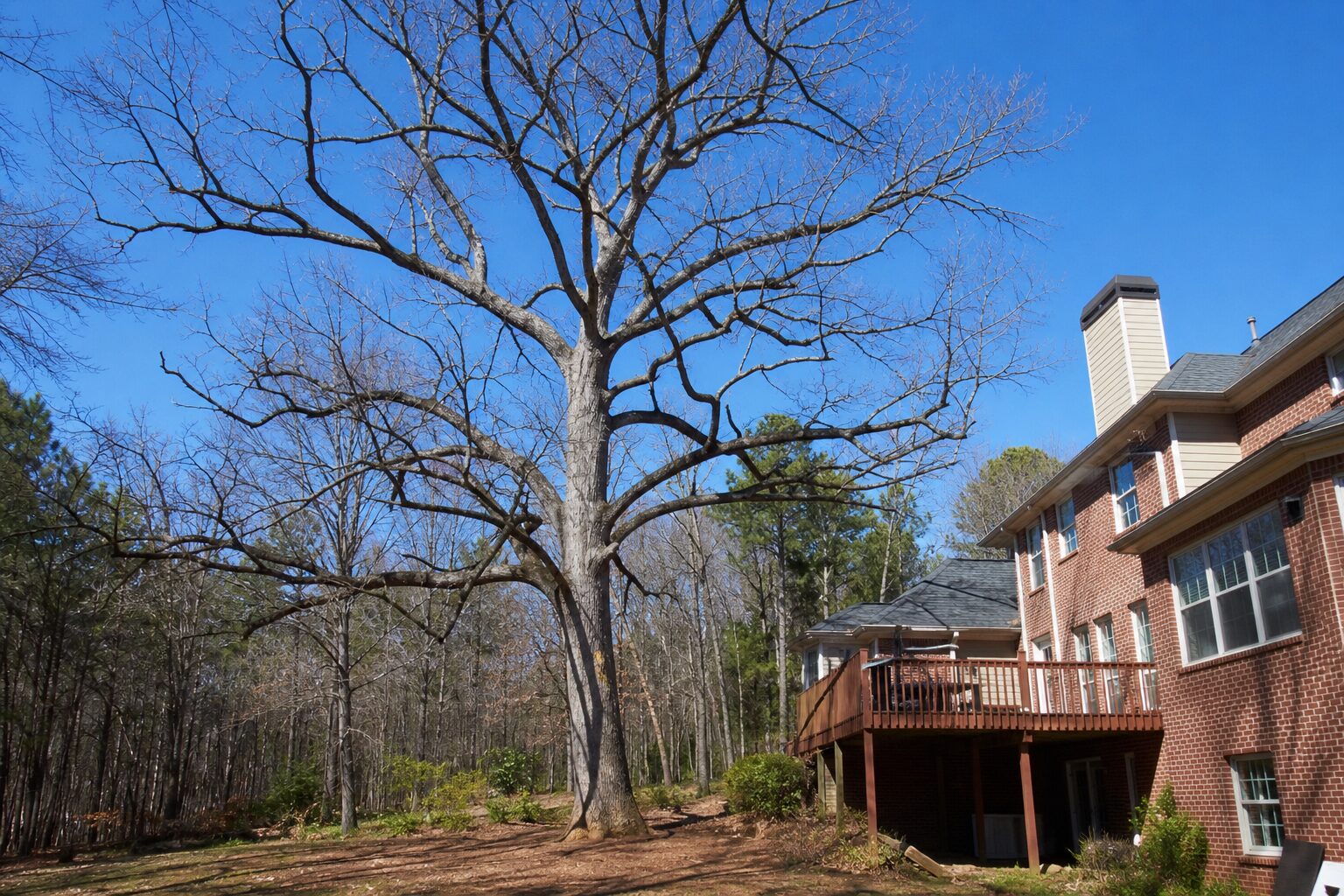
- Retained hardwood buffers are the local signature. Developers left strips of woods between subdivisions and along creeks. Those trees grew up in a forest — tall, skinny, with high crowns and no lower branches — and then the forest around them got cut. Trees that developed with neighbors sheltering them fail fast once they’re exposed. This is the single most useful piece of local tree knowledge for Suwanee
- Suwanee Creek and its tributaries thread through the whole city. Wet clay, riparian trees, and the greenway corridor mean saturated-soil uprooting is common
- 1990s subdivision plantings maturing at once: Bradford pears splitting, river birches shedding, Leyland cypress rows failing in patches — whole streets hit the same problem in the same year
So when we are out around Morningview, Settles Bridge and Suwanee Station, those are the first things we check. If you are anywhere near Sims Lake Park and George Pierce Park, or off Lawrenceville-Suwanee Road, you are well inside our normal run.
~21,000 in the city proper, with a much larger population using a Suwanee mailing address. High median household income. Very family-oriented — this is a “we moved here for the schools” market with a strong sense of community identity built around Town Center Park events. Housing is predominantly 1992–2010
Housing is 1992–2010, densely wooded with retained hardwood buffers between subdivisions The buffer-tree insight: forest-grown trees left standing after the surrounding woods came down fail fast once exposed. This is the local expertise flag The River Club and Olde Atlanta Club = golf communities with HOA architectural review
Pronounced “suh-WAH-nee.” “Town Center” means Town Center Park and it’s the center of civic life. “PIB” for Peachtree Industrial Boulevard. “Lawrenceville-Suwanee Road” is often just “Lawrenceville-Suwanee.” Residents identify strongly with the city and its events calendar That matters more than it sounds, because when somebody calls and says which side of town they are on, we already know the access and the tree cover before we get there.
Spring severe season takes the exposed buffer trees. Summer thunderstorms. Fall is planning season — after the leaves drop, homeowners can see the dead wood and they call. Winter dormant pruning is an easy sell to this planner mindset Because of that, the same tree can be a straightforward morning in one month and a genuinely awkward job in another, and we would rather tell you that up front than discover it with a machine already on your lawn. For the wider picture on tree condition and care in this region, Trees Are Good (ISA) publishes solid homeowner guidance.
The second invoice, and how to avoid it
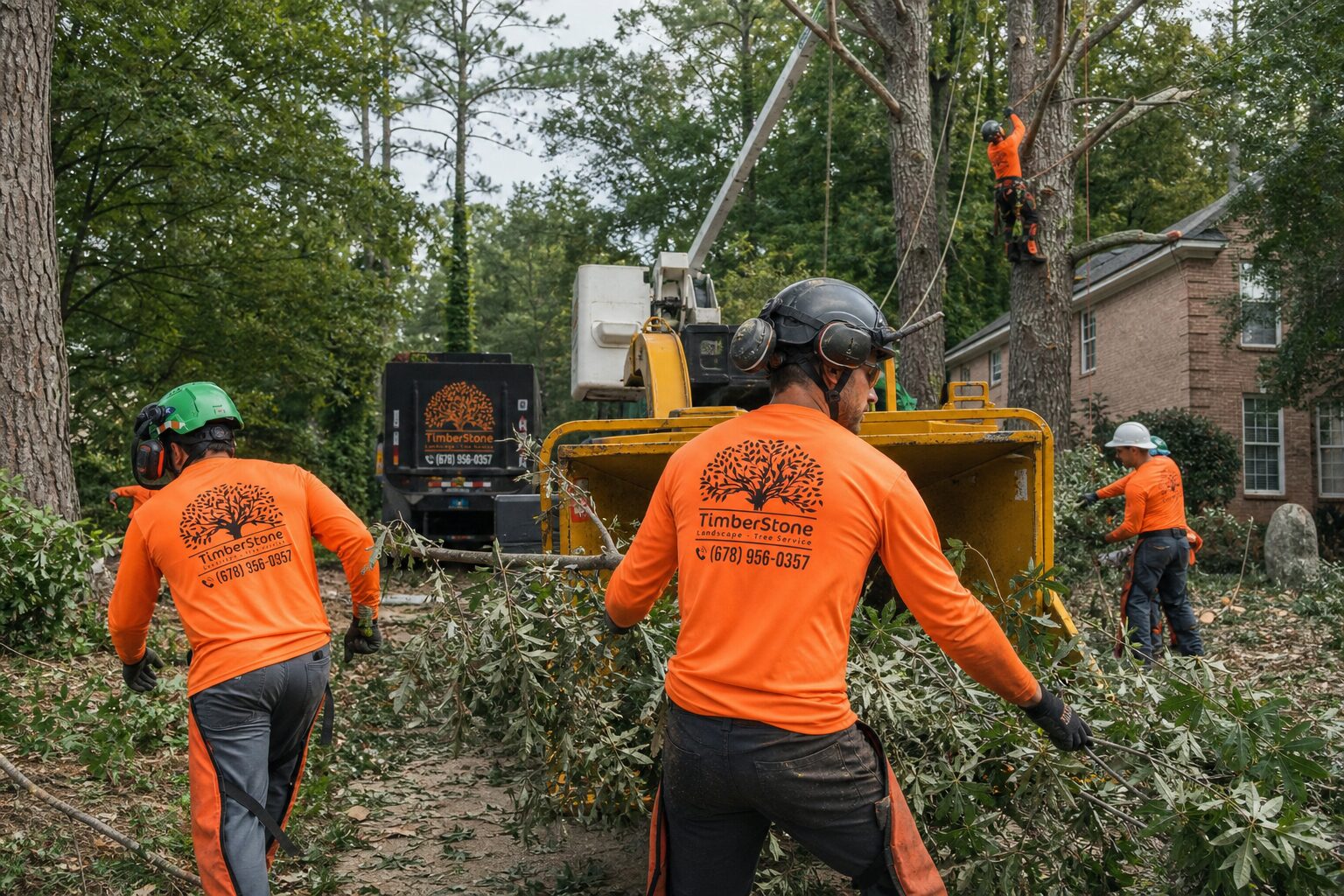
We put exclusions in writing as well as inclusions, because the second invoice is the single most common complaint in this trade and it is entirely avoidable.
Some of it is also insurance. An uninsured crew genuinely can charge less, right up until something goes wrong on your property and you are the one holding it. That is also why we put the reasoning in writing. You can read what we are seeing and decide for yourself, instead of taking our word for it. If you want the longer breakdown, we walk through it on our tree service quotes Suwanee page.
Ask what is excluded. That is where the second invoice comes from.
How to read a written quote
A real estimate names the trees, describes the work on each, and states what happens to the debris and the stump. A single line and a total is not an estimate.
And it should be free. Charging for a residential estimate is unusual, and a paid estimate that turns into a sales pitch is worse than useless.
It should explain what would change the number. Finding decay once the work starts is a real possibility and the estimate should say how that gets handled.
It should reference insurance, and the certificate should be available on request without hesitation or delay.
It should say who is doing the work. Subcontracting is common and not automatically a problem, but you should know before the day.
The worrying stops, which is worth more than most people expect going in.
But here’s what most people get wrong about this
Here is what most homeowners never get told: the number on a quote is mostly a story about access, not about the tree. Two identical oaks, one by the driveway and one behind a fence in the back corner, are genuinely different jobs.
The five drivers, in order
Size and species next. Height and diameter drive the material volume, and dense hardwood is slower to cut and heavier to move than pine.
Then targets. Anything that cannot be dropped has to be rigged and lowered piece by piece, and on a tree over a conservatory that is most of the day.
Access first. It is the factor people underestimate most and it swings the number more than size does on a typical residential job.
Then the fixed costs behind all of it: insurance, equipment, maintenance and a trained crew. That is the part that separates a company from a truck.
What happens on a quote visit
Then we come out. Photos help but they flatten distance and hide access, and access is usually the biggest single factor in the price.
On site we measure, look at the lean and the root plate, and work out where each piece is going to land or be lowered to.
We check the route in. Gate widths, soft ground, overhead lines and whether a machine can get close enough all change the method and therefore the cost.
We ask what you want afterward. Stump gone or left, chips kept or hauled, rounds stacked or taken. Those are real cost items and they should be your choice.
The seasonal timing angle nobody thinks about until it’s too late
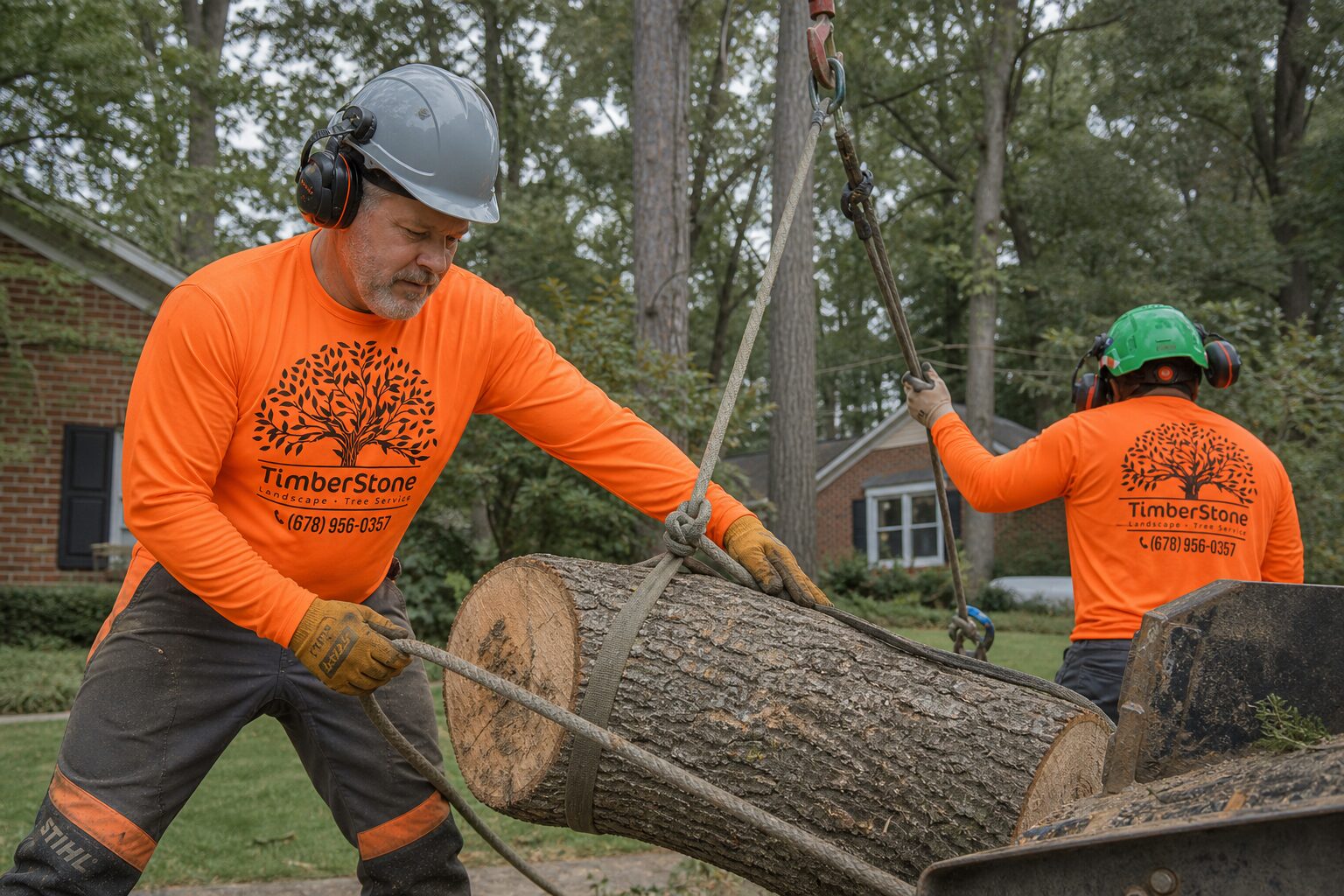
Ask any company this one question before they set foot on the property: how is each piece coming down? A company that has thought about the job will answer straight away, in detail. One that has not will talk about how long they have been doing this. The first answer tells you they planned it. The second tells you they did not.
While you are at it, ask for the certificate of insurance. Ask before the work, not after. Any real company sends it the same day, and Georgia Forestry Commission is a reasonable place to understand why that paperwork protects you and not just us.
What you are actually comparing
And ask for it in writing. A verbal number is not a scope, and it settles nothing when the work turns out bigger than expected.
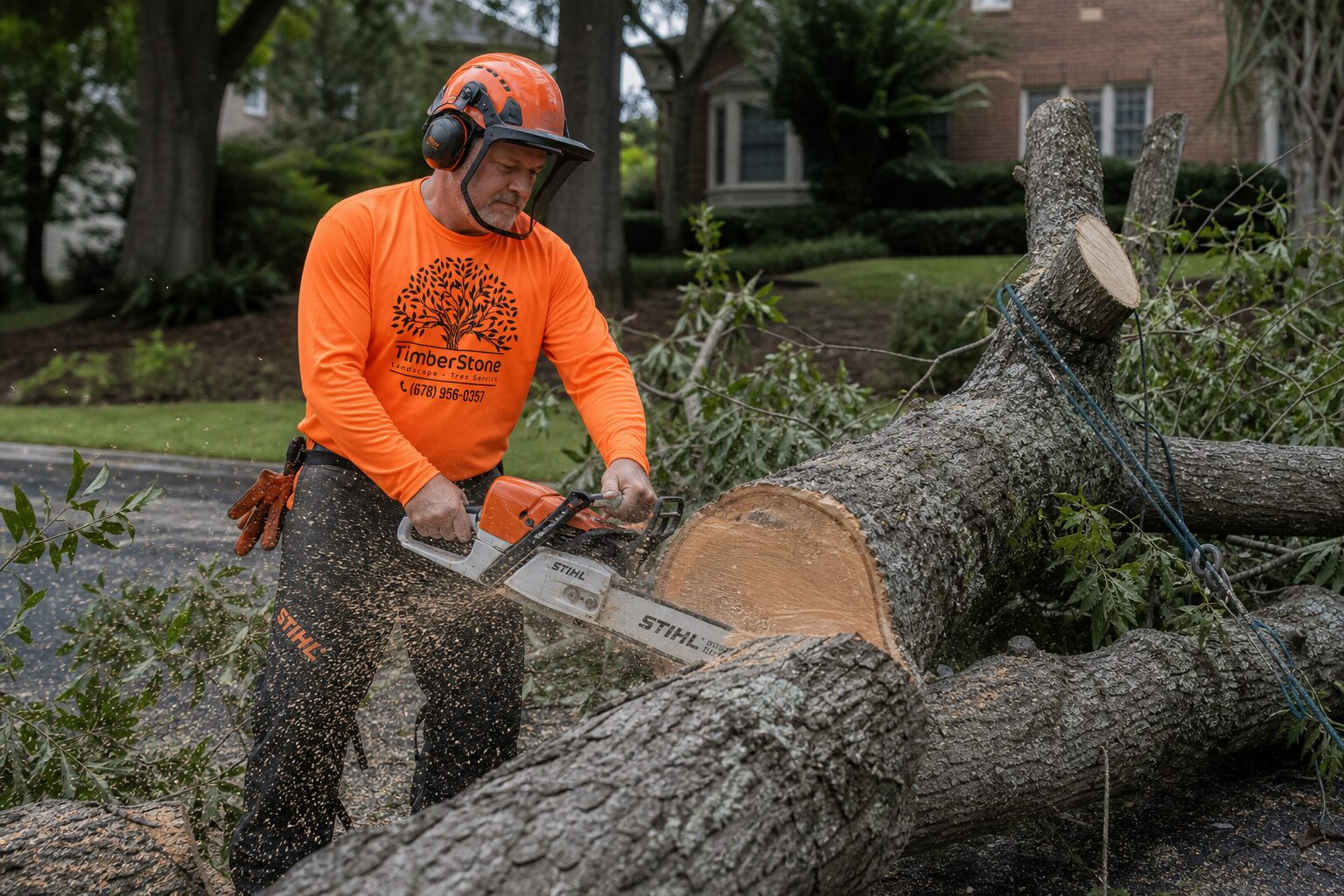
Stump grinding is nearly always separate, and it should be listed separately so you can decide rather than discover. Because of that, we always start at the base and work up, rather than starting with the part of the tree you can see from the kitchen window.
What sits underneath decides the method. A tree over open lawn can be felled. A tree over a roof, a pool or a fence comes down in rigged pieces, and that is hours instead of minutes.
The reassuring part is that the estimate itself is free, so getting a real number costs you nothing but an hour.
Your quote checklist
- Is this written down, with a scope, rather than just a number?
- What happens to the price if you find something once you start?
- How is each piece coming down near the house?
- Who is doing the work, your crew or a subcontractor?
- Can I see the certificate of insurance before work starts?
- What exactly is excluded from this number?
If two or more of those are true, it is worth having somebody look. But if none of them are, the tree is probably fine and you can stop thinking about it.
Timing: what actually matters and what doesn’t
Late winter is the easiest window for most tree work. The leaves are off, so the structure is visible, the ground is usually firm enough for equipment, and the trees are dormant.
And if the work is already overdue, the honest answer is that waiting another season rarely makes it cheaper. It usually makes it bigger.
The week after a big storm is the worst time to book non-urgent work, because every crew in the metro is triaging emergencies. Two weeks later the schedule opens right back up.
Three ways this job turns expensive
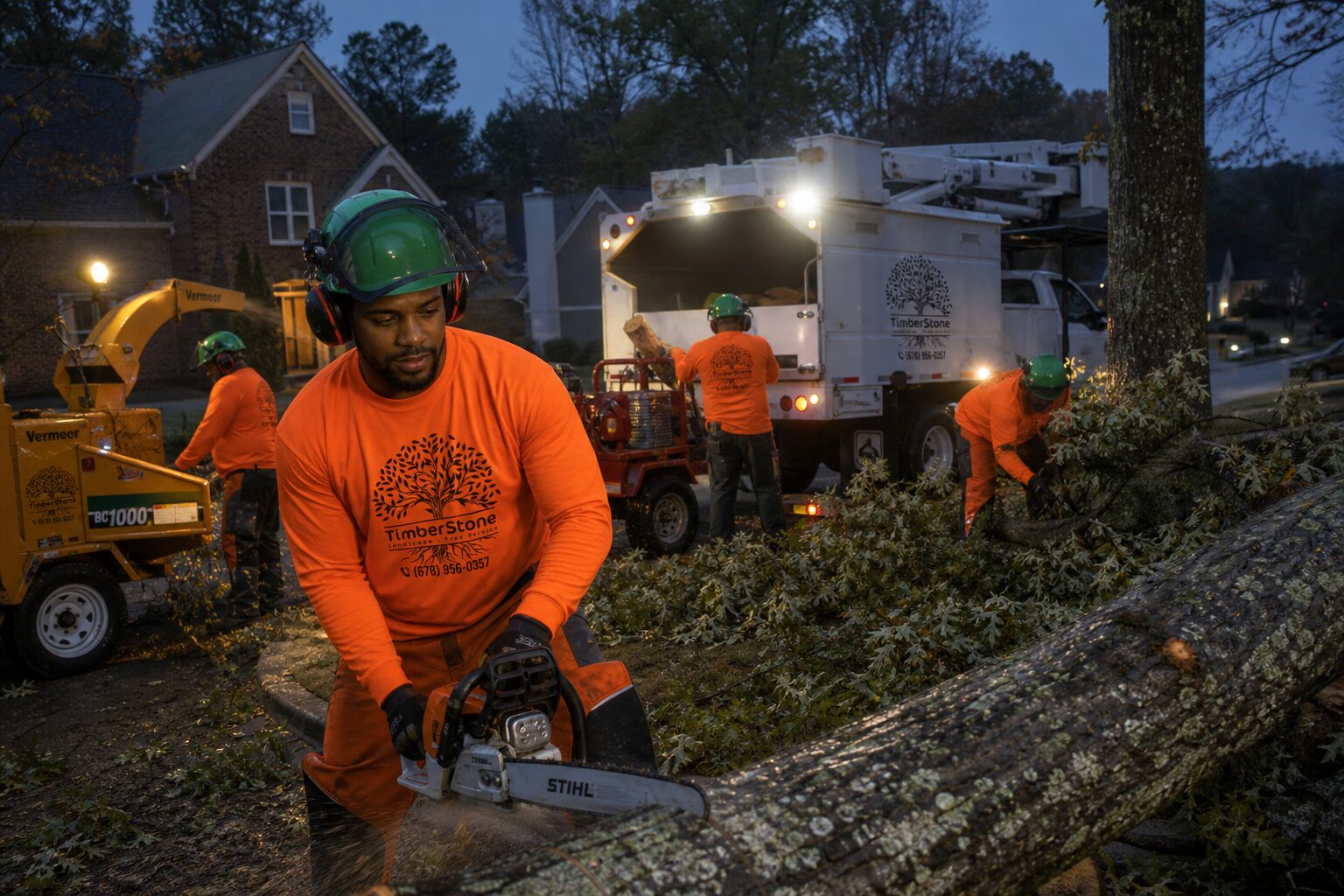
Hiring someone with the wrong equipment for the access you have. The right machine for a tight back yard is not the biggest one on the trailer, and forcing it is how lawns get destroyed.
The most expensive mistake is waiting on something you already know is a problem. Scheduled work is cheaper than emergency work, every time, and the gap is not small.
Letting a crew work without agreeing cleanup in advance is how people end up with debris across the lawn and a bill that says haul-off, additional.
Skipping the written scope because the guy seemed decent. He probably is. It still costs nothing to have it on paper, and it removes every argument later.
Where you stand afterward
And you know whether the work was genuinely needed, because a company willing to say it can wait has told you where you stand.
You have a written scope, so the work that happens is the work you agreed and the invoice matches the estimate.
You can compare three quotes meaningfully, because you know which five things drive the number and which questions expose a thin scope. If you are thinking further ahead, our affordable tree removal Suwanee page covers what the rest of the property might need, and affordable tree removal Tucker is useful if you are comparing options nearby.
Keep reading
Where We Work Around Suwanee
Where We Work Around Suwanee
We cover a wide stretch from the Loganville shop, and these are the communities we are in most often. Beyond Suwanee itself, we’re regularly out in Buford, Sugar Hill, Duluth, Lawrenceville, Johns Creek, Dacula, Braselton and Flowery Branch. Same crews, same equipment, same cleanup standard, wherever the job is. And we’re proudly serving all of Metro Atlanta from the same shop, so if you’re just outside that list, still call. For the service overview, see cost, estimates & insurance in Suwanee.
Questions We Get About Cost, Estimates & Insurance in Suwanee
Is the stump included?
Almost never by default, in anyone’s quote. It should be listed separately with a grinding depth so you can decide. If a quote does not mention the stump, ask.
What if you find something once you have started?
We tell you and we agree it before we carry on. Our estimates say how that gets handled, because discovering decay mid-job is a real possibility on older trees.
Is the cheapest quote a bad idea?
Not automatically. Read what it includes first. If it matches on scope and the company is insured, it is a fine choice. Most of the time it does not match on scope.
Do you take a deposit?
Not on routine residential work. The job gets done and then you pay. Be cautious with anyone wanting most of the money up front, particularly after a storm.
Can you give me a price over the phone?
We can give you a range once we understand the tree, but a real number needs eyes on it. Access alone can double or halve a job and it does not come across on the phone or in a photo.
Why are the quotes I got so different?
Usually because they are not for the same work. Compare the scopes rather than the totals. Cleanup, haul-off and the stump are the three items that most often account for the gap.
Got a tree in Suwanee you’re not sure about?
Text a photo and we’ll tell you what we’re looking at.
(678) 956-0357