
The Honest Numbers on Commercial Tree Service in Norcross
The assumption worth dropping: commercial tree work is residential work with a bigger chipper. That said, the trees are the easy part. If you are weighing up commercial tree service Norcross right now, this covers scheduling, documentation, liability and what a workable annual plan actually looks like on a managed property.
Here is the honest answer up front. commercial tree service Norcross works when it is planned annually and fails when it is reactive, and the cost difference runs the wrong way for reactive.
What we run into around Norcross specifically
A Victorian-era historic district with the highest-consequence residential trees in the footprint, wrapped around one of Gwinnett’s biggest commercial corridors That shapes almost everything about how a job gets planned here.
- Buffer requirements between commercial and residential zoning mean a lot of neglected tree strips that legally have to stay but practically need managing
- 1960s–80s residential canopy with the same end-of-life water oak and over-tall pine problem as Lilburn
- Beaver Ruin and Crooked Creek bottomland — saturated clay, uprooting
- Historic district legacy trees — enormous old oaks over 100+ year-old wood-frame houses on small in-town lots, with power lines and neighbors on every side. Highest-consequence residential work in the footprint. Crane and rigging
So when we are out around the Indian Trail corridor, the Norcross Historic District and the Lillian Webb Park area, those are the first things we check. If you are anywhere near the Jimmy Carter commercial corridor and Norcross Station, or off Holcomb Bridge Road, you are well inside our normal run.
the historic district around Thrasher Park and Lillian Webb Park has Victorian-era and early-1900s homes under genuinely old trees. Beyond it, most of Norcross is dense 1960s–1980s residential and a very large commercial/industrial/warehouse belt along I-85 and Jimmy Carter
Zoning buffer strips between commercial and residential must stay but need managing Historic railroad town — the Norcross Historic District around Thrasher Park and Lillian Webb Park Parking-lot island and buffer-strip trees get ignored for years, then fail onto vehicles. Liability-driven work
“Historic Norcross” or “downtown Norcross” means the district around Thrasher Park. “Jimmy Carter” is the boulevard and a whole commercial identity. “Buford Highway” is a cultural corridor as much as a road. “Eighty-five” for I-85. Note carefully: Peachtree Corners residents do not want to be called Norcross even though they had Norcross mailing addresses for decades — keep the two cities distinct in copy That matters more than it sounds, because when somebody calls and says which side of town they are on, we already know the access and the tree cover before we get there.
Spring severe season. Summer storms. Commercial customers plan on fiscal calendars, not weather — off-season commercial scheduling is a real advantage because the crew is available when homeowners aren’t calling Because of that, the same tree can be a straightforward morning in one month and a genuinely awkward job in another, and we would rather tell you that up front than discover it with a machine already on your lawn. For the wider picture on tree condition and care in this region, Georgia Forestry Commission publishes solid homeowner guidance.
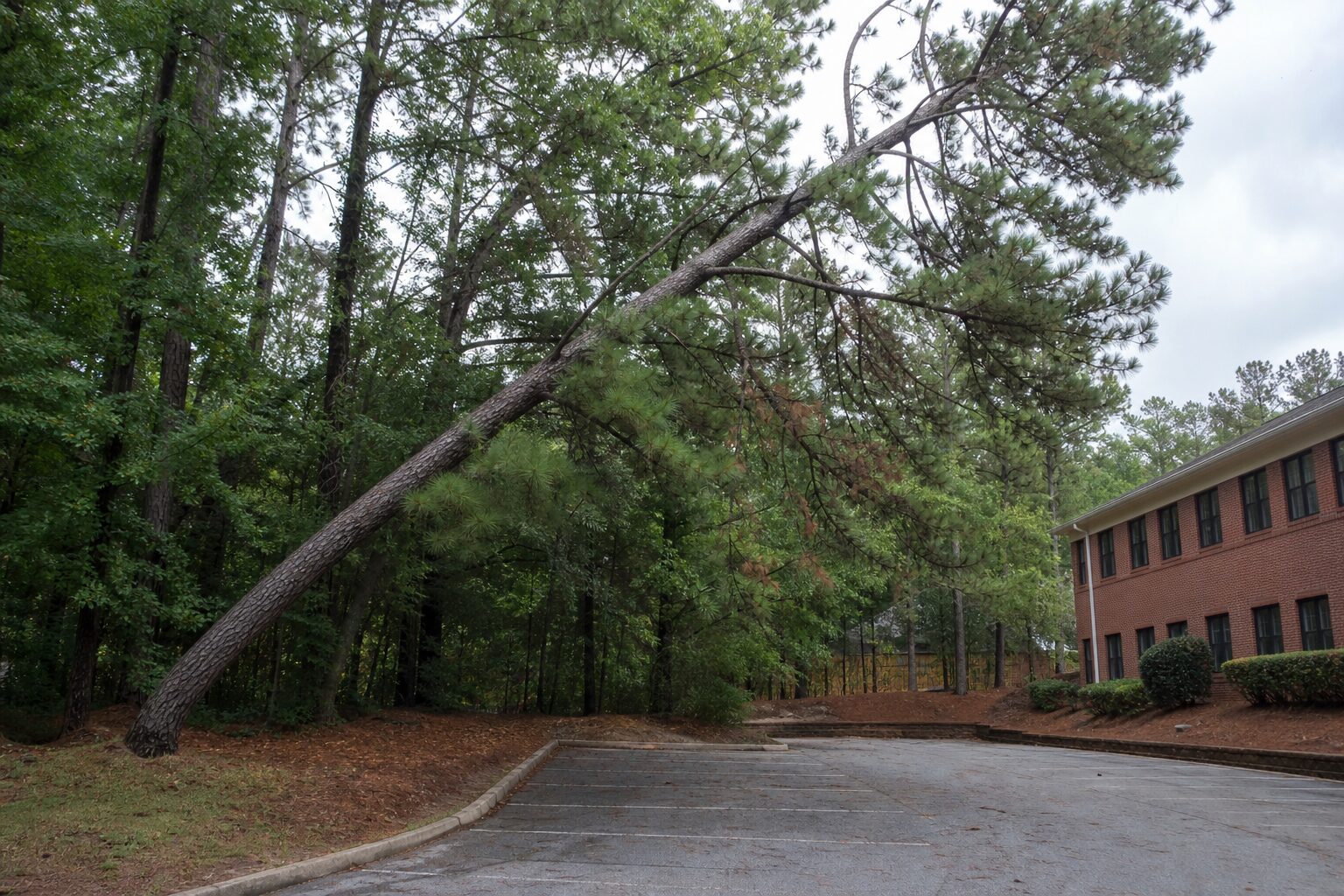
What managers actually want
Reactive work is more expensive in every direction: emergency rates, unplanned budget, resident disruption and the liability exposure in between incidents.
And one point of contact matters more than managers admit. Not a call centre, not a different estimator each time, and not a subcontractor who has never seen the site. That is also why we put the reasoning in writing. You can read what we are seeing and decide for yourself, instead of taking our word for it. If you want the longer breakdown, we walk through it on our commercial tree care cost Norcross page.
A documented, declined recommendation is still documentation. Keep it.
Everything between the walk-through and the schedule
Commercial engagements start with an inventory rather than a bid, because a single quote on the complaint tree tells a board nothing about its actual exposure.
Every tree of consequence gets a condition note and a recommendation, and the output is a prioritised list with reasoning attached.
Insurance is sorted before scheduling. Certificate issued, entity named as additional insured where required, and limits checked against your standards.
Scheduling then works around the property: retail early, offices at weekends, multifamily at civilised hours with notice issued to residents.
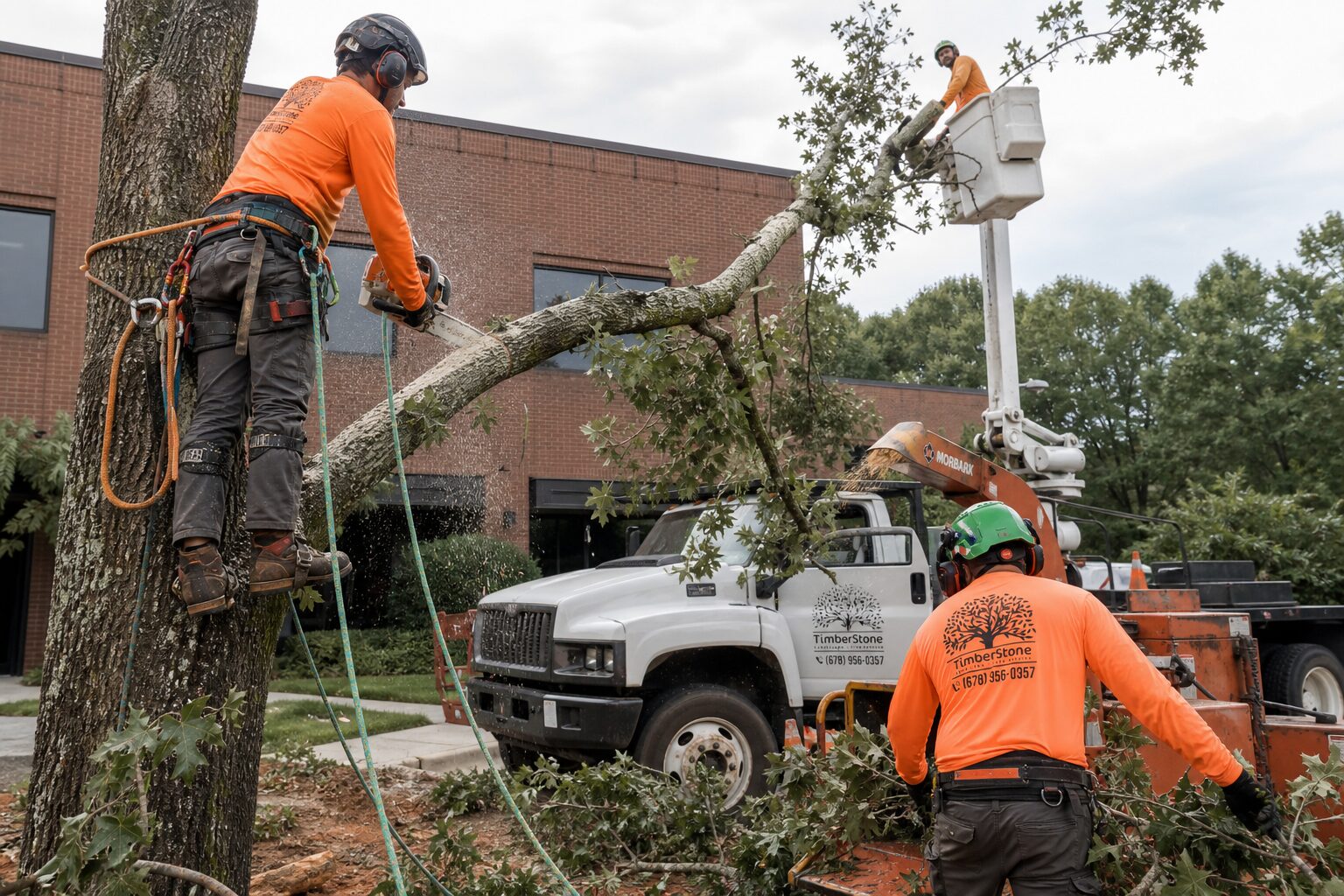
On site there is access control, signage where vehicles move, and a crew briefed on where they may and may not park and stage.
There is a clear next step, and it starts with one phone call.
Real talk: this is where the two kinds of tree companies split apart
Here is what most homeowners never get told: the number on a quote is mostly a story about access, not about the tree. Two identical oaks, one by the driveway and one behind a fence in the back corner, are genuinely different jobs.
Inside a commercial engagement
And a review before the next cycle, so the plan reflects what has changed rather than repeating last year’s list.
That becomes a prioritised plan with the reasoning attached, in a form a board or an owner can actually read and approve.
Work is executed in scheduled blocks with access control on site, cones and signage where vehicles move, and a crew that knows where it is allowed to park.
It starts with a full property walk. Every tree of consequence gets looked at, not just the ones generating complaints, because the complaint tree is usually not the risk tree.
What moves the number
Access control adds time. Cones, signage, a banksman where vehicles move and staged closures all take crew hours that a back garden does not require.
Out-of-hours work carries a premium. Weekend and early-morning scheduling to keep a property functioning is a real cost and it should be visible in the quote.
Commercial pricing works the same way residential does underneath: access, targets, size and cleanup. The difference is scale and scheduling constraints.
And the comparison that matters is against reactive spending, which arrives unpredictably at emergency rates and cannot be budgeted at all.
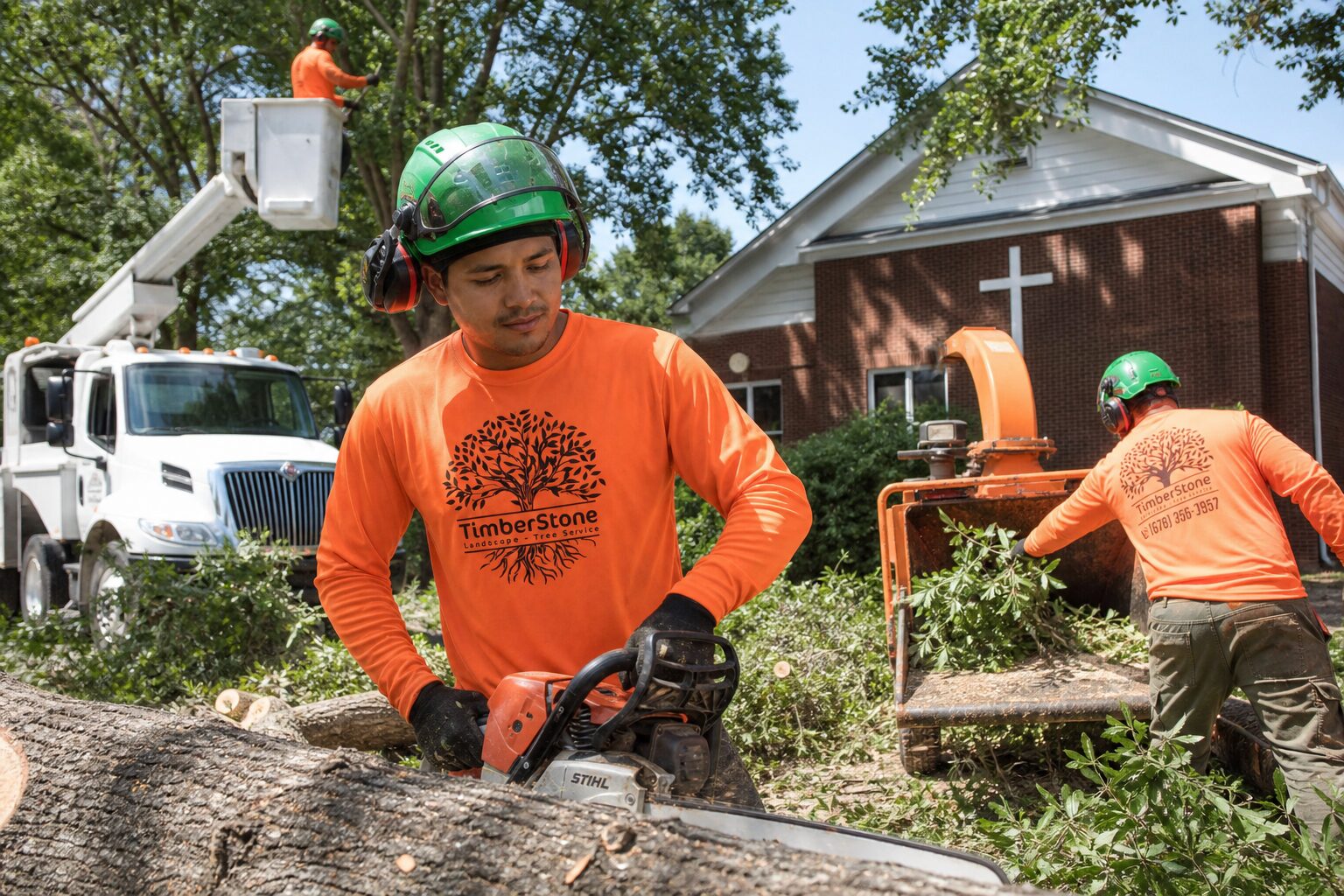
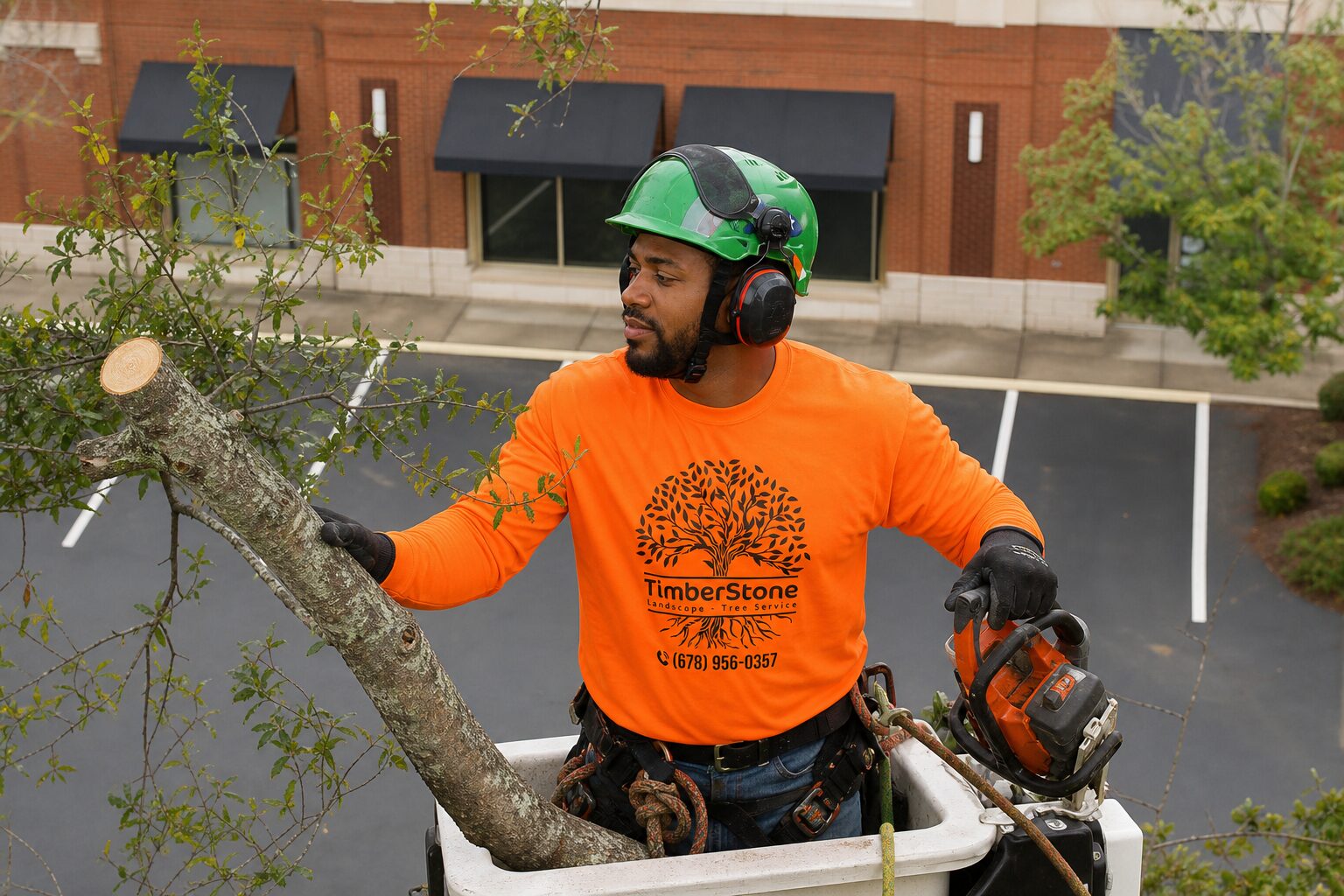
A short walk-through of what the crew is actually thinking while they work
Ask any company this one question before they set foot on the property: how is each piece coming down? A company that has thought about the job will answer straight away, in detail. One that has not will talk about how long they have been doing this. The first answer tells you they planned it. The second tells you they did not.
While you are at it, ask for the certificate of insurance. Ask before the work, not after. Any real company sends it the same day, and Georgia Power is a reasonable place to understand why that paperwork protects you and not just us.
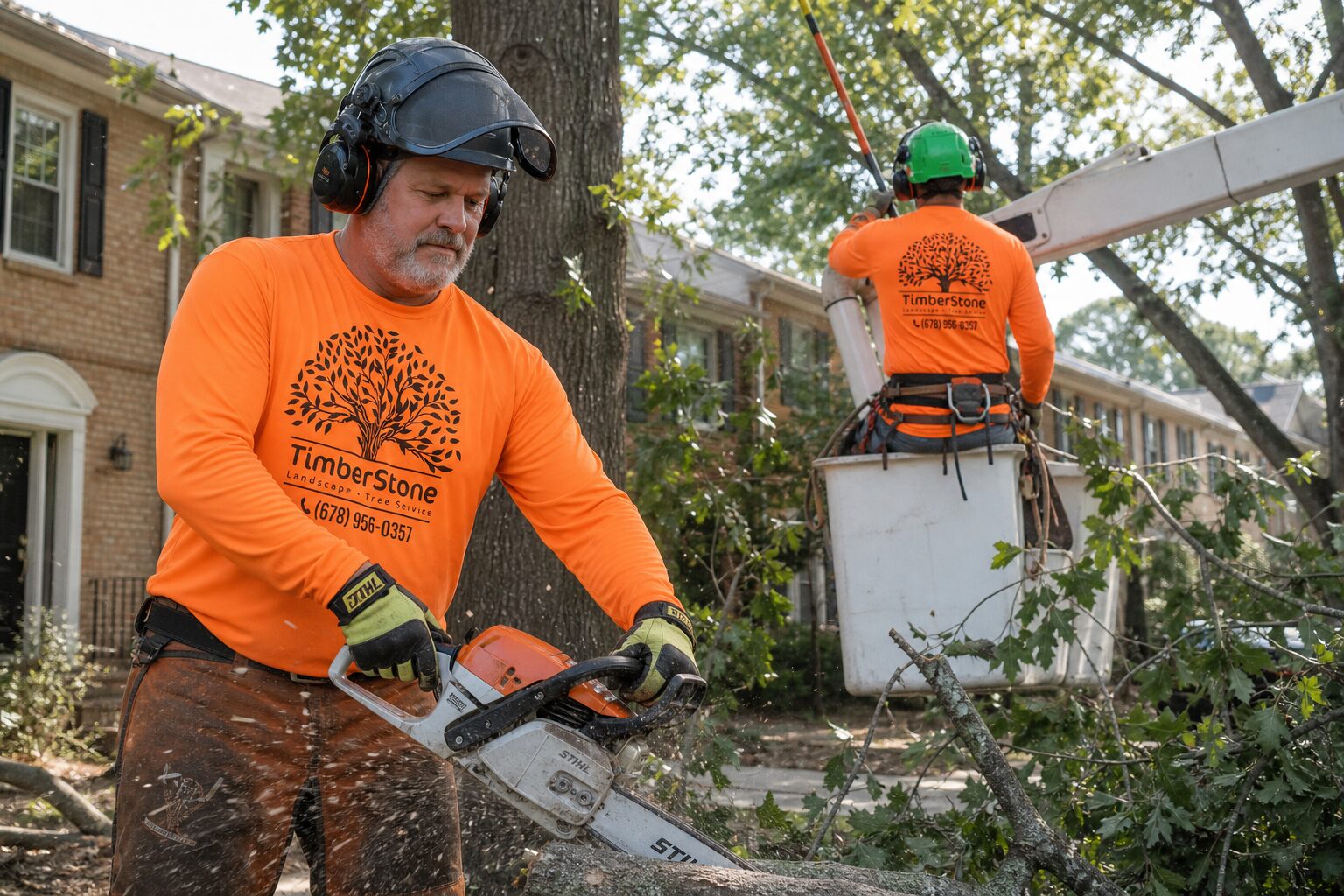
Is this urgent, or is this a spring project?
The week after a big storm is the worst time to book non-urgent work, because every crew in the metro is triaging emergencies. Two weeks later the schedule opens right back up.
And if the work is already overdue, the honest answer is that waiting another season rarely makes it cheaper. It usually makes it bigger.
Late winter is the easiest window for most tree work. The leaves are off, so the structure is visible, the ground is usually firm enough for equipment, and the trees are dormant.
The advice we’d give if you weren’t paying us
Get two or three quotes, and don’t automatically take the cheapest. Ask each one how they plan to do the work and what happens to the debris. The answers separate them faster than the prices do.
Write down what you were told on the phone. If the number changes when the invoice arrives, having the original scope in writing settles it in about a minute.
Be suspicious of anyone who quotes without walking the property, and be more suspicious of anyone who knocks on your door after a storm asking for money up front.
Ask who is actually doing the work. Some outfits sell the job and subcontract it out, which is how you end up with a crew that never saw the quote you agreed to.
None of that is complicated, and none of it requires you to know anything about trees. Instead it just means asking two or three questions before the work starts rather than after, because once a crew is in your yard with a saw running your position is weaker.
Liability, scheduling and paperwork
Insurance requirements are stricter than residential. Additional-insured status, specific coverage limits and sometimes workers compensation certificates are gating items.
Timing is a real constraint. Retail wants early mornings, offices want weekends, and multifamily wants anything except six in the morning under a bedroom window. Because of that, we always start at the base and work up, rather than starting with the part of the tree you can see from the kitchen window.
And continuity matters. A property with a different contractor every year has no history, which means every visit starts from nothing.
The encouraging bit is that documented, planned maintenance is exactly what an insurer wants to see.
Questions worth answering first
- Are there any trees already flagged by an insurer, a surveyor or a resident?
- Who is the single point of contact on your side?
- How much notice do residents or tenants need, and who issues it?
- Which entrances and routes have to stay open at all times?
- Which hours and days work for the property, and which are impossible?
- Who needs to be named on the certificate of insurance, and to what limits?
If two or more of those are true, it is worth having somebody look. But if none of them are, the tree is probably fine and you can stop thinking about it.
After the first year
You have a certificate on file and one person to call, which removes most of the friction from the relationship.
You have a budgetable annual number instead of unpredictable emergency spending, which is the thing boards actually want.
And the property looks maintained rather than reactive, which residents notice and which shows up in how the site is perceived. If you are thinking further ahead, our property manager tree service Norcross page covers what the rest of the property might need, and commercial tree care cost Tucker is useful if you are comparing options nearby.
Keep reading
Where We Work Around Norcross
Where We Work Around Norcross
Loganville is home base, so the surrounding towns are a short run rather than a special trip. Beyond Norcross itself, we’re regularly out in Duluth, Lilburn, Tucker, Doraville, Berkeley Lake, Chamblee, Lawrenceville and Stone Mountain. Same crews, same equipment, same cleanup standard, wherever the job is. And we’re proudly serving all of Metro Atlanta from the same shop, so if you’re just outside that list, still call. For the service overview, see commercial, hoa & property management in Norcross.
Questions We Get About Commercial & HOA Tree Service in Norcross
Can you give us a multi-property schedule?
That is most of our commercial work. One walk-through per property, one plan, one contact, and a schedule that fits your approval calendar.
Do you handle emergency calls for managed properties?
Yes, and managed properties are prioritised during storm events, because access and liability are usually urgent on an occupied site.
Can you provide a certificate of insurance?
Yes, before the first crew arrives. Tell us who needs to be named as additional insured and what limits your standards require, and we will have it issued.
What documentation do we get?
Dated records of what was inspected and what was done, with photographs, plus a written note of anything recommended and not approved. That last part is what protects a board.
Can the work be spread over several years?
Usually, and it is often sensible. Genuine hazards get handled in year one and the remainder stages across the following two, which keeps the annual number predictable.
Do you work around business hours?
Yes. Early mornings and weekends are normal for retail, office and multifamily sites. Out-of-hours scheduling carries a premium and we show it as a line rather than burying it.
Got a tree in Norcross you’re not sure about?
We’ll come out, walk the property, and explain the options.
(678) 956-0357